8 Best AI SEO Tools 2026 [Ranked, and What I'd Skip]
 Luciano Viterale
 This article contains affiliate links, but almost none of these are. The only affiliate relationship I have here is SE Ranking. Every other tool on this list I'm recommending for free, and I earn nothing whether you buy it or not. No brand saw this article before it went live, and no tool got a better ranking because of a commission. If something is overpriced for what it does, I'll say so. Read my full affiliate and editorial disclosure here.
On this page
There's a whole category of SEO tool that didn't exist two years ago, and half of them are already priced past the point of being worth it.
They go by different names.
AI SEO tools. GEO tools.
AEO tools.
AI visibility platforms.
The pitch is always the same: AI search is eating your clicks, so you need to know whether ChatGPT and Perplexity and Google's AI answers mention you, and pay us monthly to find out.
A lot of that is real. These tools are genuinely useful. But the prices have run way ahead of the value, and almost every roundup you'll read was written by a company that sells one of the tools on it. Go and check. The tool ranked number one is, funny enough, always the one publishing the list.
I sell almost none of these. I do my own SEO every day, on this site and others, and I've spent this year working AI search into that. Some of these I use constantly. One of them I think is genuinely overpriced to the point of being a joke. And the single most important part of AI SEO isn't a tool at all: it's a manual process I'll walk you through, that the good tools simply automate for you.
Let's get into it.
Why most "best AI SEO tools" lists are written by the tools themselves
I want to be straight with you before the list, because it changes how you should read every other article on this topic.
Generative engine optimization got hot fast. A tool category that barely existed in 2024 now has dozens of venture-funded players, and every one of them runs a content team publishing "top 10 GEO tools" roundups. Those roundups exist to rank the publisher's own product first and collect affiliate commissions on the rest. They're not independent, no matter how many comparison tables they include.
That's the game I'm not playing. I have exactly one affiliate relationship on this whole list, SE Ranking, and I genuinely don't care whether you buy it. The tools I rate highest here, Profound and Claude, pay me nothing. I'm ranking them where I'm ranking them because that's what I actually think.
Here's the honest through-line for the article. These tools do one valuable thing: they run your search phrases across every AI engine and show you where you're missing from the answers. That's real work, and doing it by hand is slow. So the good ones earn their place. But the pricing has gotten silly. Anything over about US$100 a month is hard to justify for most people, and one tool on this list costs US$828 a month, which is genuinely insane for what it is.
What to look for in an AI SEO tool
Before the list, here's the rubric I'm scoring against. It's built for AI search specifically, not the general DIY SEO software I cover separately.
Does it automate the discovery: does it run your phrases across the AI engines and show you exactly where you're absent from answers, including detailed use-case queries, not just short keywords? This is the whole reason to pay for one of these.
Does it help you act: does it stop at "you're not mentioned," or does it point you at the gaps, the sources being cited, and what to do about them?
AI-engine coverage: how many answer engines, and is the data real user data or a synthetic estimate? ChatGPT alone is not enough in 2026.
Price sanity: what does it actually cost, and does it stay under the roughly US$100-a-month line where these tools remain worth it? Over that, the value drops fast.
Ease of use: can a non-specialist get something out of it in the first week?
Each tool gets scored out of 10 across these, rolled into one number. They are not all clustered around 8. A couple score low on purpose.
The 8 best AI SEO tools
Ordered by how useful they actually are for AI search, with price sanity factored in. I sell almost none of these, so this order is just my honest read.
1. Profound: the best dedicated AI visibility tool, if you can stomach the price
Luc's Score: 9.0/10
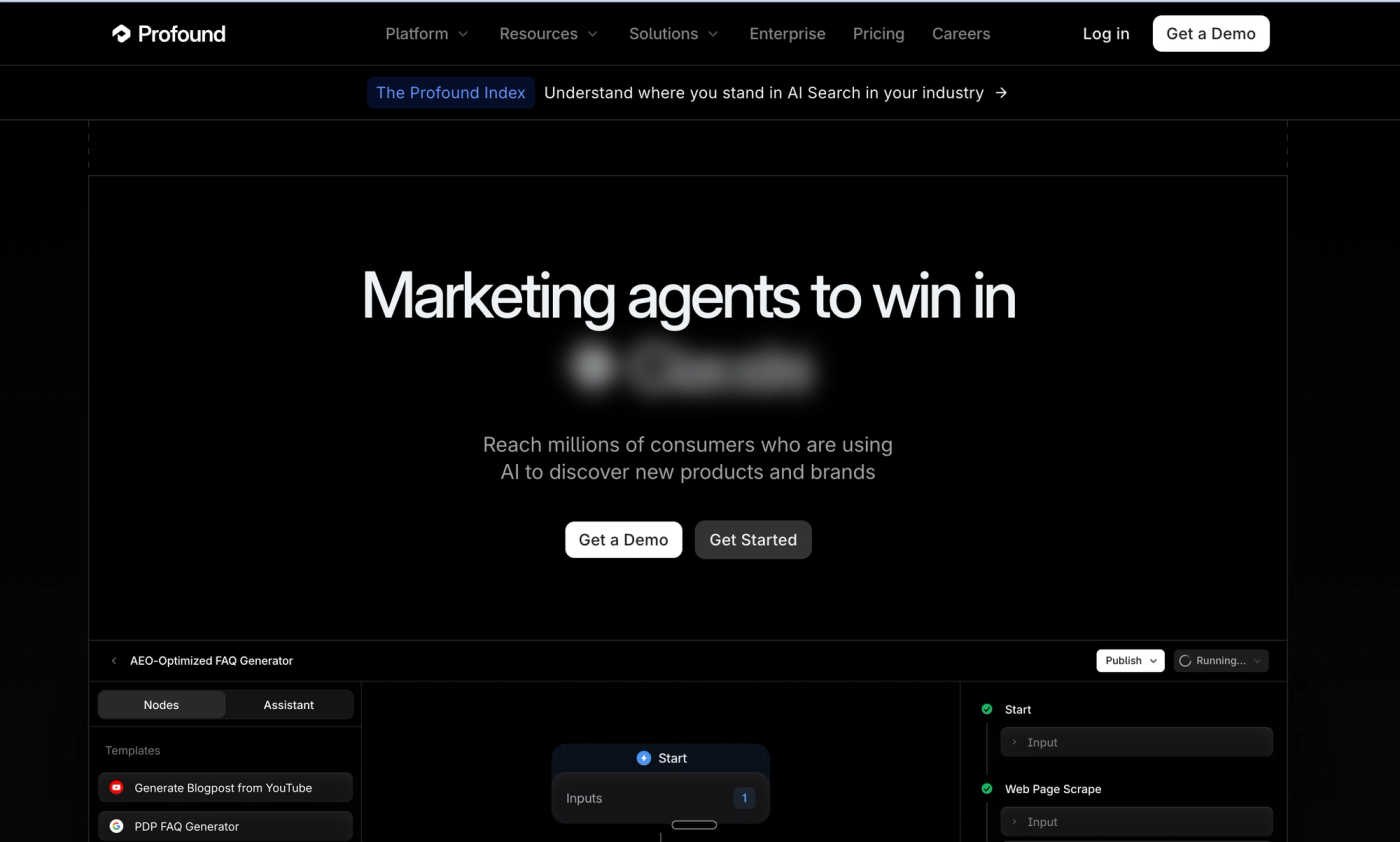
Profound is the best dedicated AI visibility tool I've used, and it's the one I'd point to if someone wanted the real thing.
It captures actual user-facing data across ten or more AI engines including ChatGPT, Claude, Perplexity, Google AI Overviews, Gemini, Copilot, DeepSeek, and Grok. Where it earns its reputation is the depth: it runs the queries you care about across all of those engines and shows you exactly where you show up, where you don't, and which sources the answers are pulling from. That last part matters, because knowing who's being cited instead of you is the start of getting in. It handles the detailed, long use-case queries too, the ones where someone describes their whole situation and asks for a recommendation, which is increasingly how people actually search.
So why the price warning. The US$99/month Starter plan tracks ChatGPT only, which is close to useless on its own. The moment you want Perplexity and Google's AI Overviews, which is the entire point, you're on Growth at US$399/month, and real deployments climb from there. It's an excellent tool at a price built for funded brands and agencies, not solo operators. I rate it number one on quality. Just go in knowing what it costs.
- Real user-facing data across ten or more AI engines
- The broadest, deepest engine coverage in the category
- Surfaces the sources being cited, not just whether you're mentioned
- Handles long, detailed use-case queries, not only short keywords
Where it bites: the meaningful features start at US$399/month, and the Starter tier's ChatGPT-only tracking isn't enough for real work. This is the tool that most tests my own "nothing over US$100 a month" rule, and it's good enough that I'll allow it, for the right buyer.
Price: Starter US$99/mo (ChatGPT only), Growth US$399/mo (three engines, 100 prompts), Enterprise custom. Annual billing lowers the rate.
Stack fit: The serious dedicated tracker. The best of the pure AI visibility tools, priced for teams and brands rather than individuals.
2. Frase: the best value way to both find the gaps and fix them
Luc's Score: 8.7/10
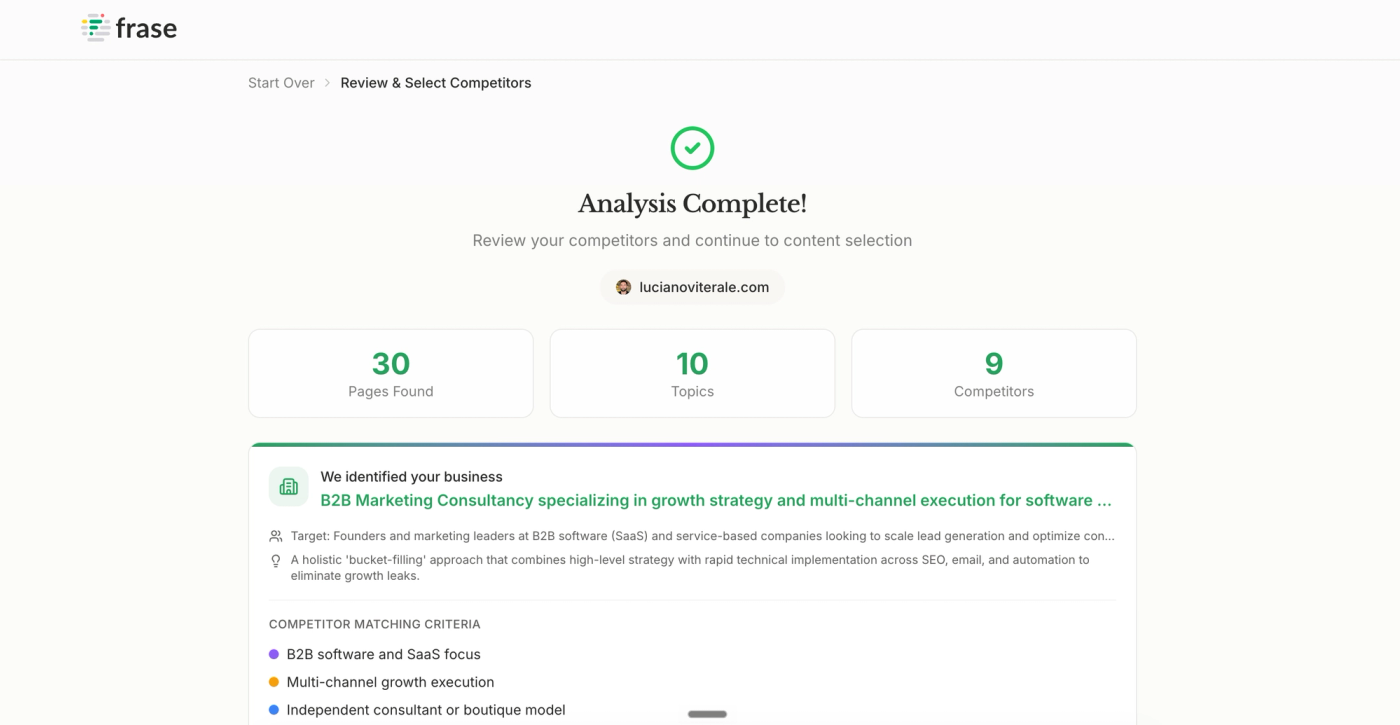
Frase is the tool I'd hand most people, because it does the two halves of the job in one place at a sane price.
It started as an AI content optimization tool, and in 2026 it folded AI-visibility tracking into every tier instead of charging extra. So in one platform you can see whether ChatGPT, Perplexity, Claude, and Gemini mention you, then move straight into the research, briefs, and scoring that help you win the answer back. That's the loop the pure trackers are missing. A tracker tells you you're invisible. Frase tells you and then helps you do something about it, without switching tools.
I've used it, and it's pretty good. It won't replace Claude for actually writing in your voice, but as a structured "here's where you're missing, here's the brief to fix it" workflow, it's the best value combination on this list. And it clears the price rule comfortably, starting at US$39 a month with GEO tracking already included.
- AI-visibility tracking included in every tier, not an add-on
- Pairs the tracking with content research, briefs, and scoring
- Covers ChatGPT, Perplexity, Claude, and Gemini
- Starts at US$39/mo with a 7-day trial, no card required
Where it costs you: the entry tier is capped on articles and audit pages, so heavy publishers climb tiers quickly. And the AI writing is fine, not exceptional. I still draft in Claude and use Frase for the structure and the gap analysis.
Price: Starter US$39/mo (annual), Professional US$109/mo, Scale US$299/mo. 7-day free trial.
Stack fit: The find-and-fix layer. If you can only add one dedicated tool, this is the one, because it actually helps you close the gaps it finds.
3. Claude: the best tool for the actual work, just not the discovery
Luc's Score: 8.5/10
Let me be clear about why Claude is here, and why it's number three and not number one.
Claude is, honestly, the most useful tool I own for doing SEO. I run it through Claude Cowork with custom skills I've built for content briefs, keyword clustering, page audits against what's already ranking, and structuring content so an AI engine can quote it cleanly. When I find a query where I'm not getting cited and I decide to build my own piece to win it, Claude is what I write it with. It's also what I'd use to draft the outreach when I want to get added to someone else's article.
But here's the honest distinction. This is a list about AI search visibility, and Claude does not do the discovery half of that job. It won't run your phrases across ten engines and show you a share-of-voice number. It doesn't measure where you're missing. It's the tool that helps you fix the gap once you've found it, not the tool that finds it. That's genuinely valuable, arguably the most valuable part, which is why it still scores an 8.5. It's just a different job from what Profound and Frase do, and on a visibility-tool list it would be dishonest to crown it number one for a thing it doesn't actually do.
- Content briefs, outlines, and drafts structured to get cited
- Builds the listicles and pages you create to win a query
- Drafts outreach to get added to existing articles
- Page audits and schema debugging in plain language
- Custom skills so it works in your voice and to your standard
The honest limitation: it's a general model, not an AI-search platform. It measures nothing across engines. You point it at the right task; it doesn't hand you visibility data. Output quality depends heavily on how well you brief it.
Price: Free tier available; paid plans from around US$20/month for the better models.
Stack fit: The workhorse. It does the fixing in every stack here. Pair it with one tool that does the finding.
4. Google Search Console: the free AI-search signal you already have
Luc's Score: 8.3/10
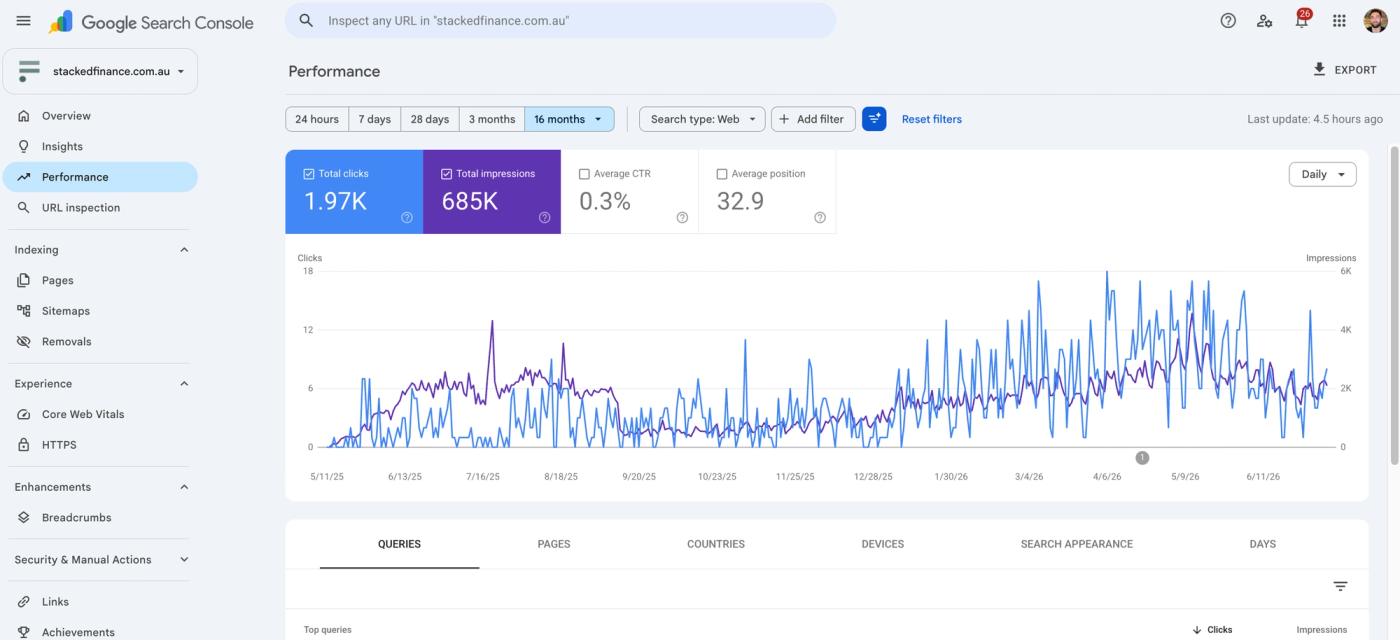
Before you pay a cent for any AI visibility tool, open the one you already have for free.
I check Google Search Console at least ten times a day. It's probably why I'm so stressed. But it's still the most honest window into how Google sees your site, and in 2026 that increasingly includes AI-driven surfaces. Impressions inside AI Overviews show up in your Performance data, and the queries where you're getting impressions but no clicks are your clearest signal that an AI answer is intercepting the click before it reaches you.
Sort your Performance report by impressions, find the queries where clicks have quietly collapsed, and you're looking at where Google's AI is answering on your behalf. That tells you which pages to rewrite so they become the source the answer quotes. It's the cheapest AI-search diagnostic there is, and it's free.
- Real query and impression data, including AI Overview surfaces
- Spot pages losing clicks to AI answers by sorting for high impressions and falling clicks
- Index coverage and technical issue flagging
- Completely free, forever
The one catch: it only covers Google and only your own site. It tells you nothing about ChatGPT, Claude, or Perplexity. That's what the dedicated tools above are for.
Price: Free.
Stack fit: The non-negotiable free base layer. Every stack here starts with it.
5. SE Ranking: the best all-in-one, with AI tracking included
Luc's Score: 8.0/10
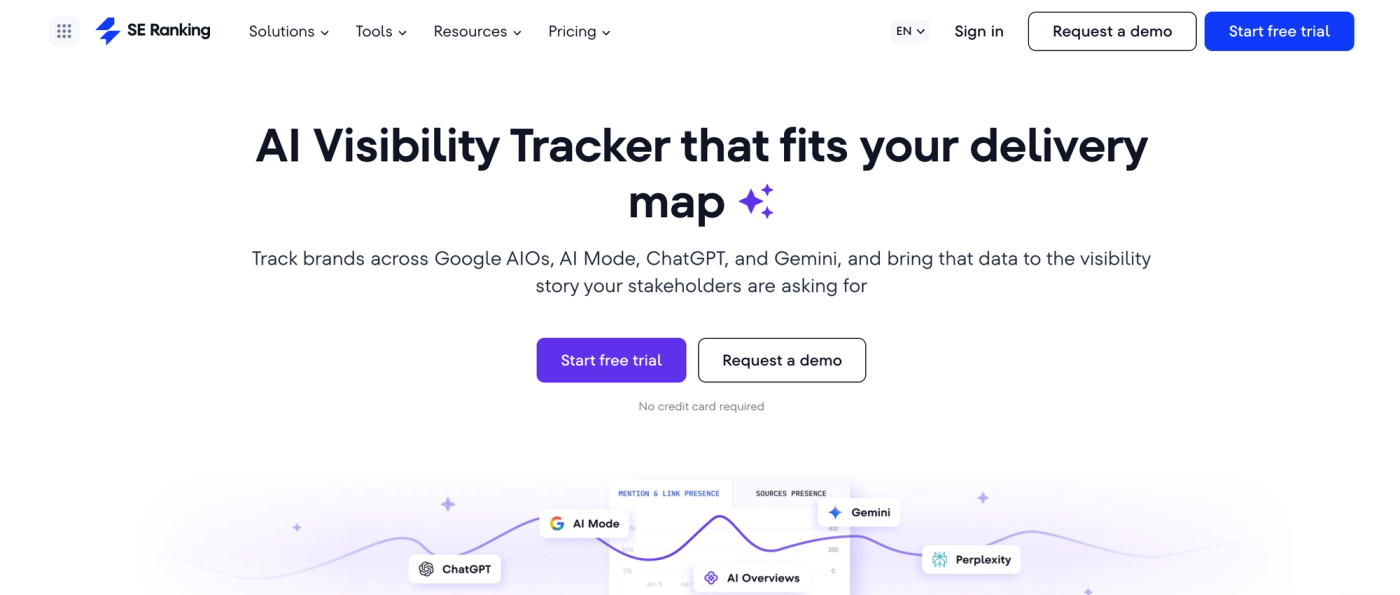
If you want one paid tool that does real SEO and AI-search tracking without buying a separate subscription for each, this is the one I've recommended for years.
SE Ranking's approach to AI search is why it belongs here rather than only on the general SEO list. Instead of charging extra for a bolt-on AI module, it tracks how you show up across ChatGPT, Perplexity, and Google's AI answers inside the same platform that already does your keyword research, rank tracking, and site audits. Your AI visibility sits right next to your actual rankings and traffic, so you can see whether the two move together. That's a genuinely useful way to work, and it's the one affiliate link on this page, which I'm telling you plainly. I've also written a full SE Ranking review if you want the deeper look.
Heads up on pricing: SE Ranking retired its old cheaper tiers in late 2025. Current plans are Core at US$129/month (US$103.20 on annual) and Growth at US$279/month, AI visibility included.
- AI visibility tracking included, not a separate purchase
- Maps AI citations to your keyword rankings and traffic
- Full SEO platform underneath: research, tracking, audits, backlinks
- Cleanest interface in its class, 14-day free trial
The trade-off: it's an all-rounder, so its pure AI-visibility depth isn't at the level of a specialist like Profound. If AI search is the only thing you care about, a dedicated tool digs deeper. If you want one tool for everything, this wins, and it's the best value all-in-one.
Price: Core US$129/mo (US$103.20 annual), Growth US$279/mo. 14-day free trial.
Stack fit: The all-in-one layer. Best single paid tool if you want AI visibility and real SEO in one place.
6. Otterly.ai: the cheapest decent tracker to start with
Luc's Score: 7.8/10
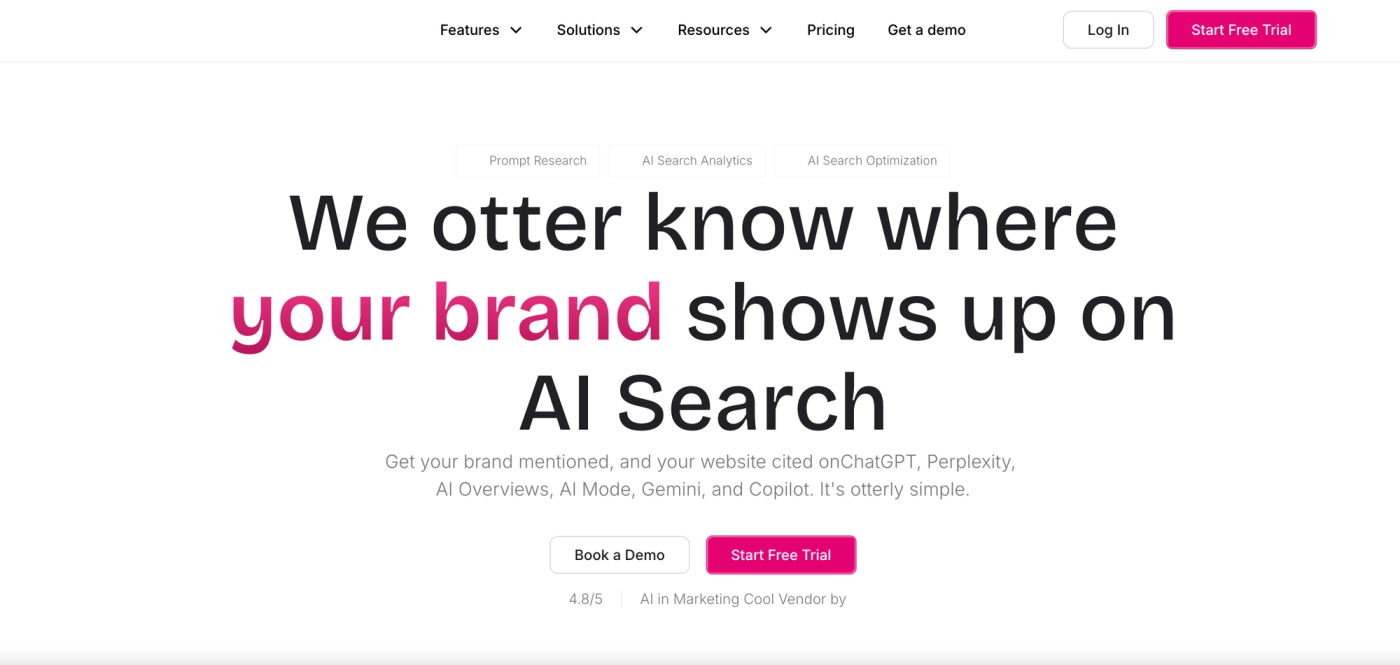
If you want a standalone AI-visibility tracker and refuse to pay enterprise money, start here. It's the cheapest real one, and it's pretty good.
You give it the prompts you care about, and it tracks how you show up across Google AI Overviews, ChatGPT, Perplexity, and Copilot, monitoring your brand mentions and which sources the answers cite. For a solo operator who just wants to know where they stand, that's the whole job, at the lowest published entry price in the category. It does the finding well. It just doesn't do much fixing, which is where Claude and a good piece of content come back in.
- Lowest entry price of any real AI-visibility tracker
- Tracks Google AI Overviews, ChatGPT, Perplexity, and Copilot
- Prompt-level brand mention and citation tracking
- Simple enough to read in a day
Where it bites: the cheap tier is genuinely limited on prompts, and Gemini and Google AI Mode are paid add-ons rather than included. It measures rather than guides.
Price: Lite from around US$29/mo (US$25 on annual), 15 prompts. Higher tiers add engines and volume.
Stack fit: The entry-level tracker. The right pick to see where you stand in AI search without spending real money.
7. Semrush AI Toolkit: fine, but only if you already live in Semrush
Luc's Score: 7.0/10
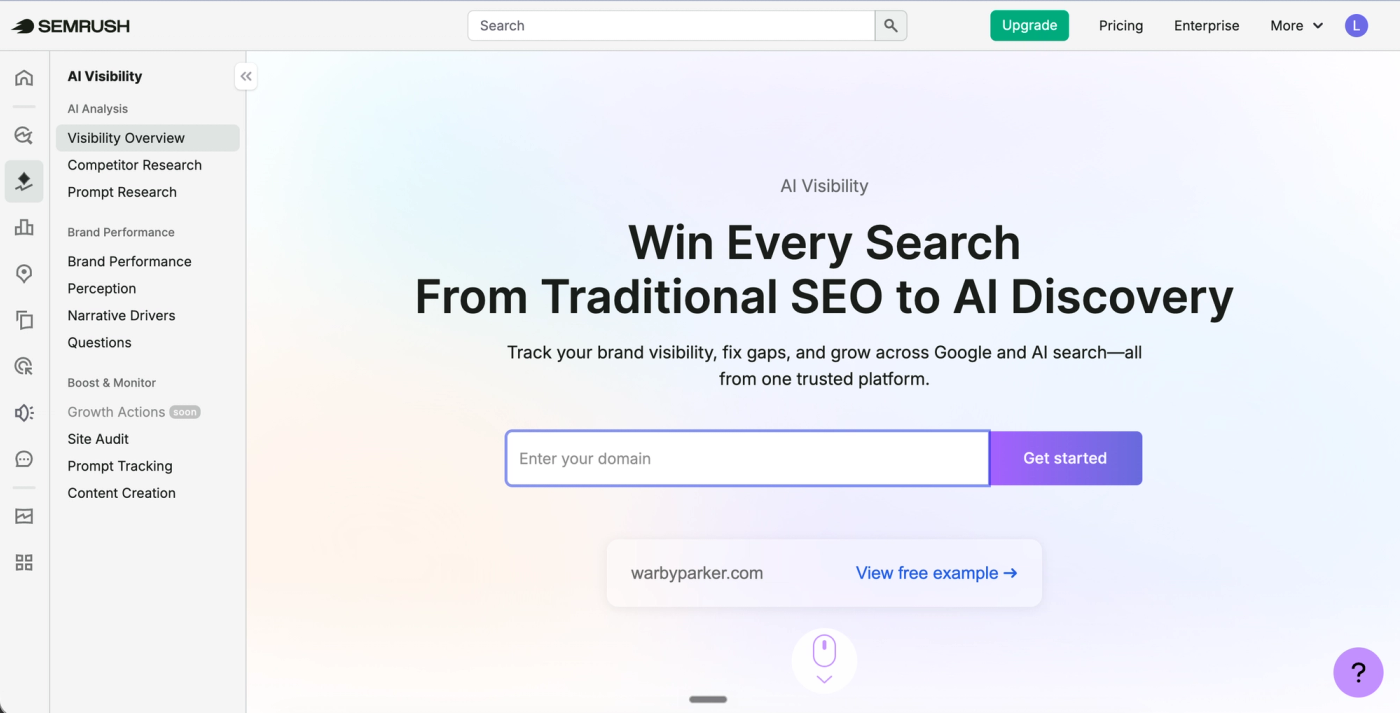
The Semrush AI Toolkit is okay for this use case. I wouldn't reach for it on its own.
It monitors Google AI Overviews, ChatGPT, Gemini, and Copilot for how often your brand shows up, with share-of-voice, prompt analysis, and competitive gap data. As a standalone add-on it runs US$99/month for one domain and 25 tracked prompts, which is a lot for a modest allowance. I'll be honest about how I touch Semrush: I run it through Gumloop inside agent workflows, mostly for competitor and ads recon, not as a daily AI-search tracker. It fits a heavier enterprise SEO stack more than a solo one. Its real case is narrow. If your team already pays for Semrush, the AI Toolkit keeps everything in one dashboard. If you're not already in that ecosystem, there's no reason to start here.
- Tracks AI Overviews, ChatGPT, Gemini, and Copilot
- Share-of-voice, prompt analysis, and competitive gap data
- Lives inside the wider Semrush platform you may already use
The catch: US$99/month for 25 prompts as an add-on to an already pricey platform. Only makes sense if Semrush is already in your stack.
Price: AI Toolkit US$99/mo add-on (one domain, 25 prompts), on top of a Semrush subscription for full value.
Stack fit: The ecosystem add-on. Worth it only if you already use Semrush.
8. Ahrefs Brand Radar: powerful, but the clearest overpricing on this list
Luc's Score: 6.0/10
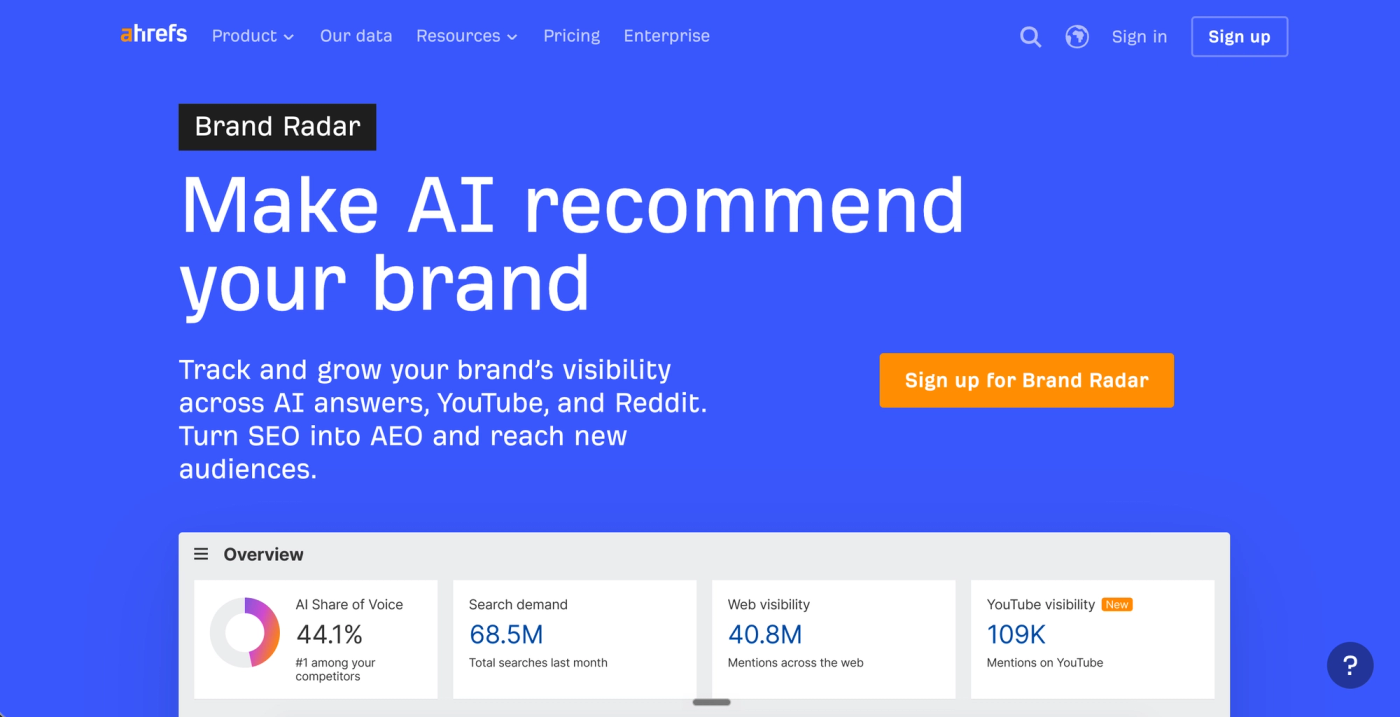
I love Ahrefs. I use the core tool daily and I recommend it with no affiliate deal. So take it seriously when I say Brand Radar is the clearest overpricing on this list.
The data is genuinely strong. Brand Radar tracks how brands show up across Google AI Overviews, Google AI Mode, ChatGPT, Perplexity, Gemini, and Copilot, drawn from hundreds of millions of real search-backed prompts rather than synthetic ones. And it sits on top of the deepest Google and AEO dataset in the business, which is the one real reason to consider it. As data, few can match it.
Now the price. Brand Radar is an add-on. The full six-platform bundle is US$699/month on top of an active Ahrefs base subscription from US$129/month, so using it properly costs around US$828/month, climbing past US$1,100 on higher tiers. That's roughly 2.5 times a dedicated AI-visibility tool, and it still doesn't natively track Claude or Grok. US$828 a month for this is, frankly, insane for almost everyone reading this. Put it this way: two months of that fee is enough to have someone build you a scrappy version that runs your queries across the engines yourself. It scores a 6.0 purely because the underlying Google and AEO data is that good. The price is indefensible for a solo operator.
- Real search-backed prompt data, not synthetic estimates
- The deepest Google and AEO data of any tool here
- Tracks six major AI engines including both Google AI surfaces
Where it bites: around US$828/month all-in, no native Claude or Grok tracking, and only defensible if you're already deep in Ahrefs for its core data.
Price: Brand Radar US$199/mo per single AI index or US$699/mo for all six, on top of an Ahrefs base plan from US$129/mo. All-in from roughly US$828/mo.
Stack fit: The premium bolt-on for existing heavy Ahrefs users only. Overpriced as a standalone AI SEO purchase, full stop.
How to actually get cited in AI search (what these tools automate)
Here's the part no vendor roundup will tell you, because it's the part you can do without paying them: the core work of AI SEO is manual, and it's simpler than it sounds.
Set aside an hour or two. Take the phrases you want to show up for and run them across every engine yourself: ChatGPT, Claude, Gemini, Perplexity, all of them. Then look at what gets cited. When you ask "best email marketing software" and ten articles get pulled into the answer and none of them include you, you've just found your target list.
Now split that list in two.
Some of those cited articles are what I'd call logistical: listicles and roundups that get updated, with a real author you can reach. For those, the move is outreach. You go to them and make the case to get included, the same way you'd earn a link. Getting added to an article that's already being cited is one of the fastest ways into the answer.
The rest, where outreach won't work, you handle by creating your own piece that deserves to be cited for that query. This is where Claude earns its spot: you build the listicle or the guide, structured cleanly so an engine can quote it, answering the actual question directly.
Then you repeat the whole thing across every engine, because they don't cite the same sources. And you go beyond the short keywords. Almost nobody types "best email marketing software" anymore. They describe their whole situation: this is our team, this is our budget, this is how we work, what should we use. Those long use-case queries are their own battleground.
That is the entire job. And now you can see clearly what the paid tools are actually for. They automate the tedious part: running hundreds of phrases across every engine and showing you, at a glance, where you're missing and who's being cited instead. They don't do the outreach or write the article. They find the gaps at scale so you can spend your hours fixing them instead of hunting for them. That's worth paying for. It is not worth paying US$828 a month for. And if you'd rather not run the loop yourself, that's what my AI SEO & AEO consulting service is for.
One more thing, looking ahead. This category is going to keep exploding, and a lot of what these tools do is not that complicated under the hood. It's already realistic to build your own version with something like Lovable, Bolt, or Vercel, wiring up the queries across engines yourself. I wouldn't be surprised to see a wave of cheap and homemade tools make the expensive ones look silly within a year.
Other AI SEO tools worth knowing
I kept the ranked list to the eight I have a real opinion on. But this category is crowded and moving fast, so here are others you'll run into, worth a look depending on your situation. I'll go deeper on these in a future piece.
Peec AI: a clean, well-liked dedicated tracker that monitors your brand across ChatGPT, Perplexity, Gemini, Grok, and AI Overviews, from €89/month. I've deliberately left it off the ranked list because I haven't used it myself, and I won't rank a tool I haven't touched. On paper it's a solid pure tracker.
Writesonic: a content platform that added AI-search tracking and tries to close the gap-to-fix loop like Frase, though the entry plan tracks ChatGPT only at around US$79/month.
AthenaHQ and Scrunch AI: advanced, brand-focused AEO platforms built for larger teams with bigger budgets.
Goodie AI: purpose-built AI answer monitoring, priced around the enterprise US$500/month mark.
LLMrefs: makes AI visibility feel like classic rank tracking. Plug in your keyword list, see how you show up across engines.
There are plenty more, and new ones launching most months. Don't feel you need to chase them. The method matters more than the tool.
How to choose: three AI SEO stacks by situation
You don't need most of the tools above. You need the right two or three for where you are.
If you're a solo operator or blogger on a tight budget:
Google Search Console (free) plus Claude (free or around US$20/mo) plus Otterly.ai (around US$29/mo). A complete AI SEO stack for well under US$60/month. GSC shows where Google's AI is taking your clicks, Otterly tells you where you stand in ChatGPT and Perplexity, and Claude does the work of building the content and outreach that gets you in.
If you're a lean in-house marketer who's been told to "do something about AI search":
Google Search Console (free) plus Frase (US$39/mo) plus Claude (around US$20/mo). Frase finds the gaps and hands you the briefs to fix them, Claude does the writing, and you've spent a fraction of the US$399/month Profound quote someone probably gave you. Swap in SE Ranking if you want full SEO in the same tool.
If you're a brand or agency that needs the deepest data:
Profound for the discovery, Claude for the fixing, and Google Search Console underneath. This is the setup where Profound's price is justified, because the depth and engine coverage actually pay for themselves across clients or a big brand. Everyone else should think hard before spending here.
The thread across all three: start with free Google data, use one tool to find where you're missing, and use Claude to actually fix it. Do not pay US$800 a month to be told you're invisible. Being told is the cheap part. Fixing it is the point.
👉 Not sure where to start? Free Search Console plus Claude plus one cheap tracker covers most people. Add depth only when you have a real question it answers.
Pricing snapshot
| Tool | Free option | Entry paid price | Note |
|---|---|---|---|
| Profound | Demo only | US$99/mo (ChatGPT only) | US$399/mo for real coverage; best data |
| Frase | 7-day trial | US$39/mo Starter | Best measure-and-fix combo |
| Claude | Yes (limited) | ~US$20/mo | The workhorse; does the actual fixing |
| Google Search Console | Yes (full) | None | Free AI-search diagnostic |
| SE Ranking | 14-day trial | US$129/mo Core | AI visibility included, best all-in-one |
| Otterly.ai | No (paid only) | ~US$29/mo | Cheapest real tracker |
| Semrush AI Toolkit | Limited | US$99/mo add-on | Only if already in Semrush |
| Ahrefs Brand Radar | No | ~US$828/mo all-in | Great data, indefensible price |
*Prices verified 9 July 2026. AI tool pricing changes fast; confirm on each vendor's site before buying.*
How I tested and chose these
I do my own SEO, daily, across this site and others, and I've spent 2026 working AI search into that day-to-day. That's the lens here: not a feature matrix compiled by a vendor ranking its own product, but what actually helps a real operator show up in AI answers.
Let me be honest about depth, because it varies. Claude, Google Search Console, and SE Ranking I use hands-on and regularly. Profound, Frase, and Otterly I've used directly and formed real opinions on. Semrush I touch through Gumloop for competitor recon rather than as a daily AI tracker, so I've told you that plainly. Ahrefs Brand Radar I'm assessing from its data, documentation, pricing, and reviews plus my daily use of core Ahrefs, rather than paying US$828 a month to run the add-on myself. Peec AI, which you'll see in a lot of roundups, I've deliberately left off the ranked list because I haven't personally used it.
Scores weigh how useful each tool is for AI search against a hard look at price. That's why an excellent tool like Ahrefs Brand Radar scores low: the data is superb, the price is not defensible for the person reading this. A low score is a comment on value, not on whether the tool is good.
FAQ
What's the best AI SEO tool if I can only pick one?
It depends what you need. For finding where you're missing across AI engines, Profound is the best if you can afford it, Frase is the best value, and Otterly is the cheapest that works. For actually fixing your visibility, Claude, because it helps you build the content and outreach that gets you cited. Most people should pair one finder with Claude, and start with free Google Search Console.
Do I actually need a dedicated GEO or AI-visibility tool?
Not to start. You can do the core work by hand: search your phrases across ChatGPT, Claude, Gemini, and Perplexity, see who's cited, and either get added to those articles or build your own. A paid tool is worth it once doing that manually across hundreds of queries eats too many hours. It automates the finding. It doesn't do the fixing.
What's the difference between GEO, AEO, and AI SEO?
Mostly marketing. GEO (generative engine optimization) and AEO (answer engine optimization) are two names for the same job: getting cited and recommended inside AI answers instead of only ranking as a blue link. "AI SEO tools" is the broad bucket that covers both the trackers that measure it and the tools that help you do the work. Don't let the acronyms convince you it's three separate disciplines.
Why is Claude only number three if it's your favorite tool?
Because this list ranks tools for AI-search visibility specifically, and Claude doesn't do the discovery half of that job. It won't run your phrases across ten engines and tell you where you're missing. It's the best tool for the fixing, which is why it still scores 8.5, but crowning it number one on a visibility list would be dishonest about what it actually does.
Why are the expensive tools not automatically the best?
Because this list scores value, not raw capability. Profound and Ahrefs Brand Radar have excellent data. Brand Radar at around US$828 a month is simply not worth it for a solo operator when a US$29 tracker plus Claude covers most of the job. Anything over about US$100 a month needs to earn it, and most of these don't for an individual.
How much should an AI SEO stack cost?
A complete starting stack runs well under US$60/month: free Search Console, around US$20 for Claude, and around US$29 for Otterly or US$39 for Frase. If you're a solo operator paying US$400 or more a month for AI-visibility tracking, you're almost certainly overpaying to measure a problem you could be spending that money fixing.
Keep reading