9 Best Enterprise SEO Tools for 2026
 Luciano Viterale
 This article contains affiliate links, and I may earn a commission at no extra cost to you if you sign up through some of them. Here's what that means in practice: no brand saw this article before it went live, no tool earned a higher ranking because of a commission, and several of the platforms here pay me nothing at all. I only recommend tools I've personally used or thoroughly researched. Read my full affiliate and editorial disclosure.
On this page
Sixty percent of Google searches now end without a click to a website.
That figure had already climbed to 68% by the first four months of 2026.
AI Overviews, ChatGPT, and Perplexity are answering questions before users ever reach your site. AI Overviews alone have reduced click-through rates for top-ranking content by 58% year-over-year.
That's not a rounding error. That's a structural shift in how search works.
For enterprise teams managing hundreds of thousands of pages across multiple domains and markets, this changes everything.
But here's what doesn't change: the fundamentals. Technical health, content quality, authority, and crawlability are still the foundation. What's changed is those fundamentals now need to feed both traditional search engines and AI-powered answer engines at the same time. That's a different job. It requires different tools.
In this guide, I've reviewed the 9 best enterprise SEO tools for 2026.
I'll tell you upfront which ones I use personally and which are based on market research, third-party data, and real contract numbers from Vendr and SpendHound. No inflated scores. No softened cons.
Best Enterprise SEO Tools: TL;DR
I know you're short on time. Here's the quick version, ordered by overall score.
- SE Ranking is the best value on this list. UI that beats tools five times the price. 🔥🔥
- Ahrefs is my personal favorite. Best data, best UI, best for competitive intelligence. 🔥🔥
- Semrush is the best all-in-one for teams who want everything in one platform.
- BrightEdge is best for Fortune 500 teams that need to justify SEO budget to executives.
- Conductor is best for content-driven enterprise teams building for AI search.
- seoClarity is best for data-heavy teams who've outgrown keyword limits on other tools.
- Screaming Frog is mandatory. Every enterprise team needs it, no exceptions.
- Botify is best for sites with 500K+ pages where crawl budget is a real problem.
- Lumar is best for cloud-based enterprise crawling and CI/CD pipeline integration.
A note on order: the list above follows overall scores. Within the tool entries below, Ahrefs appears first because it's my personal primary tool, followed by Semrush, then the rest in score order.
What Makes a Tool Actually "Enterprise" SEO?
Enterprise SEO is not regular SEO at larger scale. It's a different discipline entirely.
At enterprise level you're managing hundreds of thousands or millions of pages. You're coordinating across SEO, content, engineering, and exec teams who all want different things from the data.
You're dealing with complex site architectures, international domains, frequent deploys that can break things overnight, and stakeholders who need revenue-tied reporting, not keyword ranking updates.
The tools that work at that scale have specific capabilities that standard tools don't:
- Crawling millions of pages without hitting limits
- Multi-user workflows with role-based permissions
- Log file analysis: understanding how Google actually crawls your site, not just how it should
- Integrations with BI tools like Tableau, Looker Studio, and Salesforce
- Executive dashboards that connect SEO performance to revenue
- SSO, SOC 2 compliance, and enterprise-grade security
- GEO and AEO capabilities: tracking whether your content is being cited in ChatGPT, Perplexity, and Google AI Overviews
That last point is the big shift in 2026. Only 17% of sources cited in AI Overviews overlap with the traditional top 10 organic results. If you're only tracking rankings, you're blind to 83% of what's driving AI-generated visibility.
(Related: How to Get Cited in AI Search, my playbook for the AI-visibility side of this.)
You don't need one tool. You need a stack.
Nobody runs enterprise SEO on a single platform. Nobody.
Even teams spending $150,000 a year on BrightEdge still have Screaming Frog open in another tab. The idea of one platform handling everything is a vendor sales pitch, not a real workflow.
In every SEO program I've built or evaluated, including as Head of Growth (APAC) at Rippling, the setup runs on three layers:
Layer 1: Core SEO platform. Keyword research, competitive intelligence, rank tracking, backlink analysis, site auditing. This is where most of the budget goes. Ahrefs, Semrush, SE Ranking, BrightEdge, Conductor, and seoClarity all live here.
Layer 2: Content optimization tool. This is a separate job and needs a separate tool. Clearscope and Surfer SEO are the two I've used most. Clearscope is cleaner for editorial teams who need a straightforward content score. Surfer gives more granular NLP data if your writers and SEOs have the bandwidth to act on it. Either way, these tools analyze the top-ranking pages for your target keyword and tell you what to cover, what questions to answer, and what entities to include. Your core SEO platform doesn't do this job well enough at the actual content level.
Layer 3: Technical crawler. Screaming Frog for every team, full stop. Botify or Lumar if you're managing 500K+ pages and need continuous cloud-based monitoring instead of on-demand audits.
The tools in this article map to those three layers. The best enterprise programs pick tools that work together across all three rather than expecting one platform to cover everything. (Related: Best DIY SEO Software, for the leaner end of the market.)
What to Look for in an Enterprise SEO Tool
Here's the rubric I used to score every tool on this list. Same criteria, same weighting, every entry.
One note before we get into it: some tools here are all-in-one platforms (Semrush, BrightEdge, Conductor) and some are specialist tools (Screaming Frog, Botify, Lumar). The rubric scores them on the full set of criteria because that's how buyers evaluate tool stacks, and a low score on out-of-scope criteria is useful information. It tells you what you'll need to pair it with.
- Ease of use & team adoption: Is it accessible to non-technical stakeholders, or does it require a dedicated SEO owner to extract value?
- Technical SEO depth: Crawl scale, JavaScript rendering, log file analysis, ability to audit millions of pages.
- Keyword & competitive intelligence: Size and freshness of the keyword database, backlink data quality, SERP tracking accuracy.
- AI/GEO/AEO capabilities: Tracking AI Overview appearances, ChatGPT and Perplexity citations, AI share of voice.
- Reporting & executive dashboards: Can it connect SEO performance to revenue in a way a CFO would understand?
- Integrations: GA4, CMS, CRM, Tableau, Slack, API access, BI platforms.
- Value for money: Given the budget tier, what do you actually get?
The 9 Best Enterprise SEO Tools for 2026
1. Ahrefs
Best for: Competitive and backlink intelligence (Layer 1)
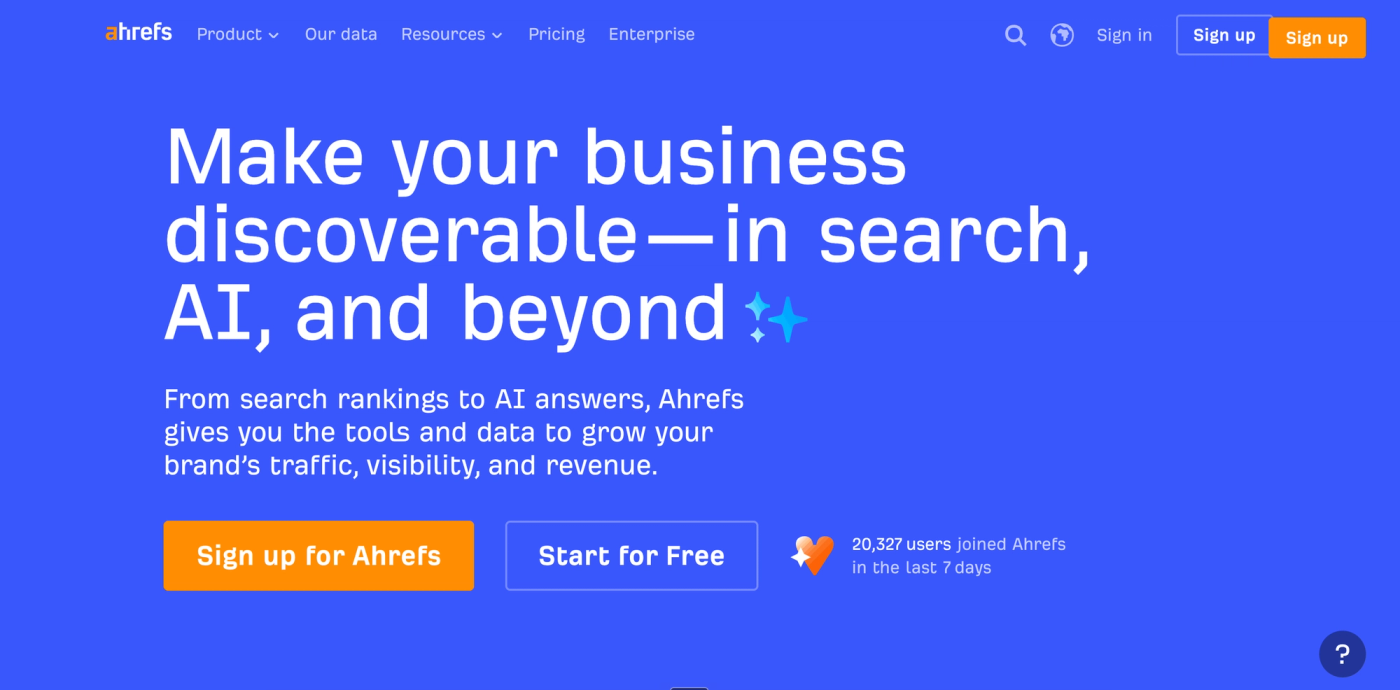
Ahrefs has been my primary SEO tool for as long as I can remember. And I don't see that changing.
The honest reason is the UI. Using most other enterprise SEO tools feels like switching from an iPhone to Android. You can do the same things eventually, but everything takes longer, the layout feels counterintuitive, and you find yourself clicking around more than actually working. Ahrefs doesn't feel that way. It's clean, fast, and logical from the first time you open it.
But the UI is just the delivery mechanism for what is genuinely the best backlink data in the industry. The index is enormous and freshly updated. If competitive research and link intelligence are at the center of your SEO program, nothing else comes close.
The Enterprise plan unlocks unlimited API access, SSO, 100 projects, 5 million crawl credits per month, and up to 10,000 tracked keywords. For large organizations running SEO across multiple domains, that removes the constant ceiling-hitting you get on lower tiers. In January 2026, Ahrefs added a $29 Starter plan, making it accessible to teams that previously couldn't justify the entry price.
Enterprise list pricing is $1,499 per month on an annual commitment, roughly $18,000 per year. Real contract data from SpendHound puts the average enterprise contract closer to $11,800 per year after negotiation, which is meaningful headroom if you go in with a competing quote.
Stack fit: Core platform (Layer 1). Pair with Clearscope or Surfer SEO for content optimization and Screaming Frog for technical auditing.
Key features:
- Largest and most frequently updated backlink index in the industry
- Site Explorer: dissect any competitor's organic traffic strategy down to individual URL and keyword level
- Keywords Explorer with click data, showing whether organic clicks are being cannibalized by ads or featured snippets
- Site Audit: up to 5 million crawl credits per month on Enterprise
- Rank Tracker: up to 10,000 keywords on Enterprise
- Unlimited API and MCP integration on Enterprise, letting you query Ahrefs data directly inside AI tools
- Project Boost Max: 24/7 monitoring, AI URL detection, and IndexNow submission for priority pages
Pros:
- Best backlink data in the industry, period
- UI is a competitive advantage over every other tool in this category
- Ahrefs Webmaster Tools provides free access for verified site owners
- MCP integration enables Ahrefs data inside AI agent workflows
- Clean, logical interface that doesn't require weeks of training to be productive
Cons:
- Data-first, not workflow-first. No shared content brief tool, no content governance layer
- AI search visibility tracking requires the Project Boost Max add-on, not native to the base plan
- Annual-only commitment at Enterprise tier
- Additional seats cost $100/month per user at Enterprise level, which compounds fast for larger teams, this was annoying for me on multiple occassions
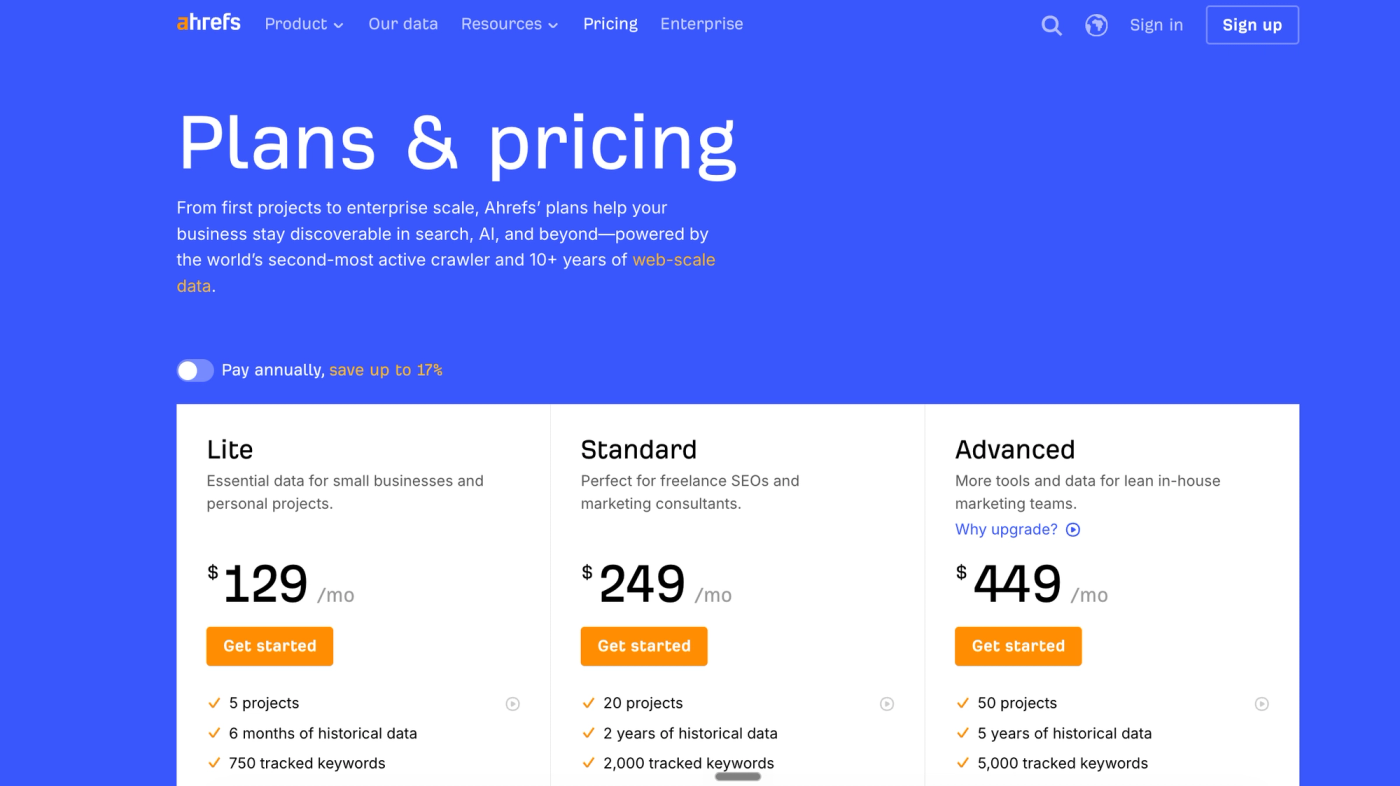
Pricing:
- Starter: $29/month
- Lite: $129/month ($108/month billed annually)
- Standard: $249/month ($208/month billed annually)
- Advanced: $449/month ($374/month billed annually)
- Enterprise: $1,499/month (annual only; avg real contract ~$11,800/year per SpendHound)
Luc's Score: 8.0/10
| Criteria | Score |
|---|---|
| Ease of use & team adoption | 9/10 |
| Technical SEO depth | 8/10 |
| Keyword & competitive intelligence | 10/10 |
| AI/GEO/AEO capabilities | 6/10 |
| Reporting & executive dashboards | 7/10 |
| Integrations | 8/10 |
| Value for money | 8/10 |
| Overall | 8.0/10 |
2. Semrush
Best for: All-in-one enterprise teams (Layer 1)
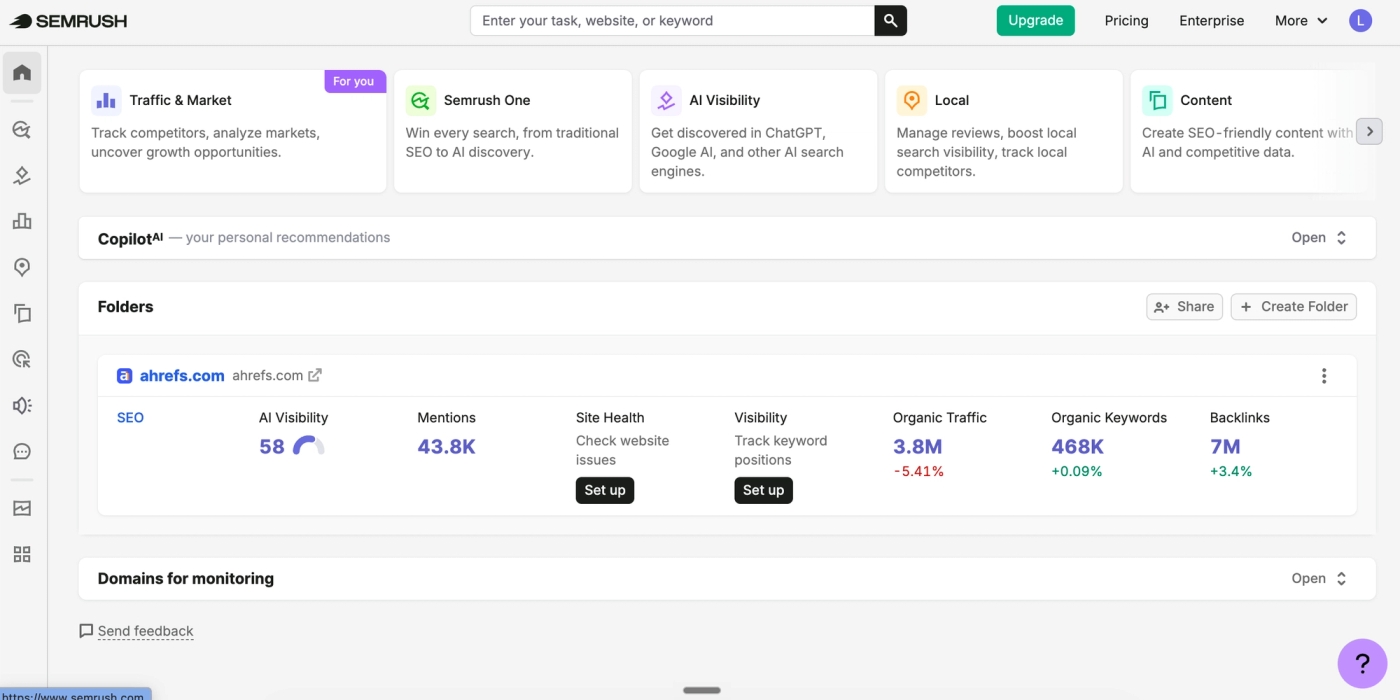
Semrush is the most widely used SEO platform in the world, and it's earned that position. It covers more ground in one login than almost anything else: keyword research, backlink analysis, site audits, competitor tracking, content optimization, social media, and now AI visibility through Semrush One. If your team needs one platform that handles the majority of your SEO workflow, this is it.
I use Semrush differently to most people.
My main use case is connecting it to Gumloop to run AI agents for competitive research and GTM workflows. When you pipe Semrush's data into an agent-based system, the research tasks you can automate are genuinely impressive. It's not something most people talk about, but if you're building AI-assisted growth processes, Semrush as a data source rather than a manual UI is worth exploring.
For traditional SEO work, the Business plan at $499.95 per month gives you 40 projects, 5,000 tracked keywords, API access, and site audits up to 1 million pages per month. That's genuine enterprise-tier capability at a price point well below the major pure-enterprise platforms.
Watch the add-ons. Traffic and Market Trends costs $289 per month on top of your plan. AI Visibility is another $99 per month. Per-seat costs stack fast. A team of five on the Guru plan pays roughly $6,340 per year once you add seat costs, not the $2,988 the headline pricing implies. Always model the real cost before you sign.
Stack fit: Core platform (Layer 1). Pair with Clearscope or Surfer SEO for content optimization (Semrush's native content tools help but don't replace a dedicated optimization layer) and Screaming Frog for forensic technical work.
Key features:
- 55+ tools covering SEO, content, competitive research, and paid search in one platform
- Site audit crawls up to 1 million pages per month on Business
- Semrush One bundles AI visibility tracking with traditional SEO tools in a single subscription
- 500+ integrations including GA4, Looker Studio, and HubSpot
- Share of Voice tracking on Business and above
- API access on Business tier and above, enabling custom dashboards and agent-based workflows
Pros:
- Covers more SEO workflows in one platform than almost any alternative
- Semrush One makes AI visibility accessible without a separate tool
- Business plan API access enables agent-based automation
- Negotiable enterprise pricing with competitive quotes
- Strong content marketing toolkit on Guru and above
Cons:
- Add-ons significantly inflate the real cost above the headline price
- Rank tracking accuracy lags behind dedicated trackers at granular location level
- Per-seat costs compound fast for teams of five or more
- UI is denser and less intuitive than Ahrefs
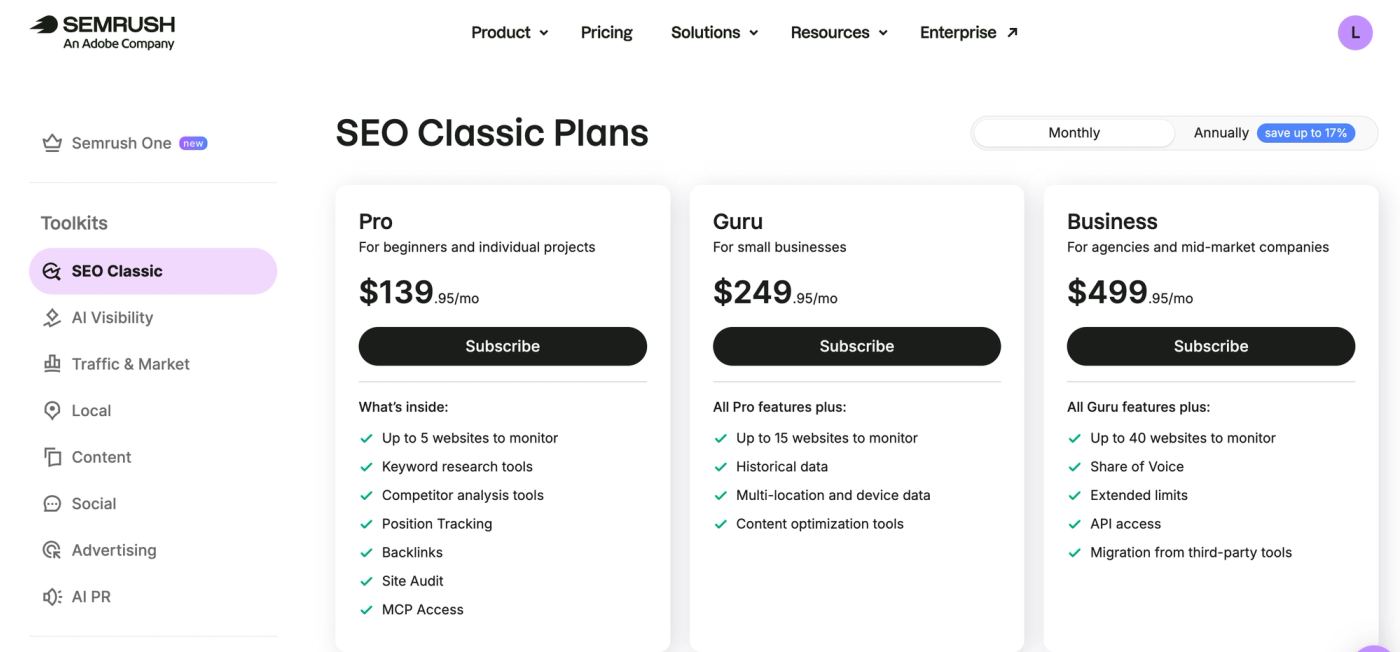
Pricing:
- Pro: $139.95/month
- Guru: $249.95/month
- Business: $499.95/month (40 projects, 5K keywords, API access, 1M page audits)
- Enterprise: Custom (avg ~$18,240/year per SpendHound real contract data)
- Semrush One (SEO plus AI Visibility bundled): from $199/month
Luc's Score: 7.9/10
| Criteria | Score |
|---|---|
| Ease of use & team adoption | 8/10 |
| Technical SEO depth | 8/10 |
| Keyword & competitive intelligence | 9/10 |
| AI/GEO/AEO capabilities | 7/10 |
| Reporting & executive dashboards | 7/10 |
| Integrations | 9/10 |
| Value for money | 7/10 |
| Overall | 7.9/10 |
3. SE Ranking
Best for: Teams that want enterprise-level features without a six-figure contract (Layer 1)
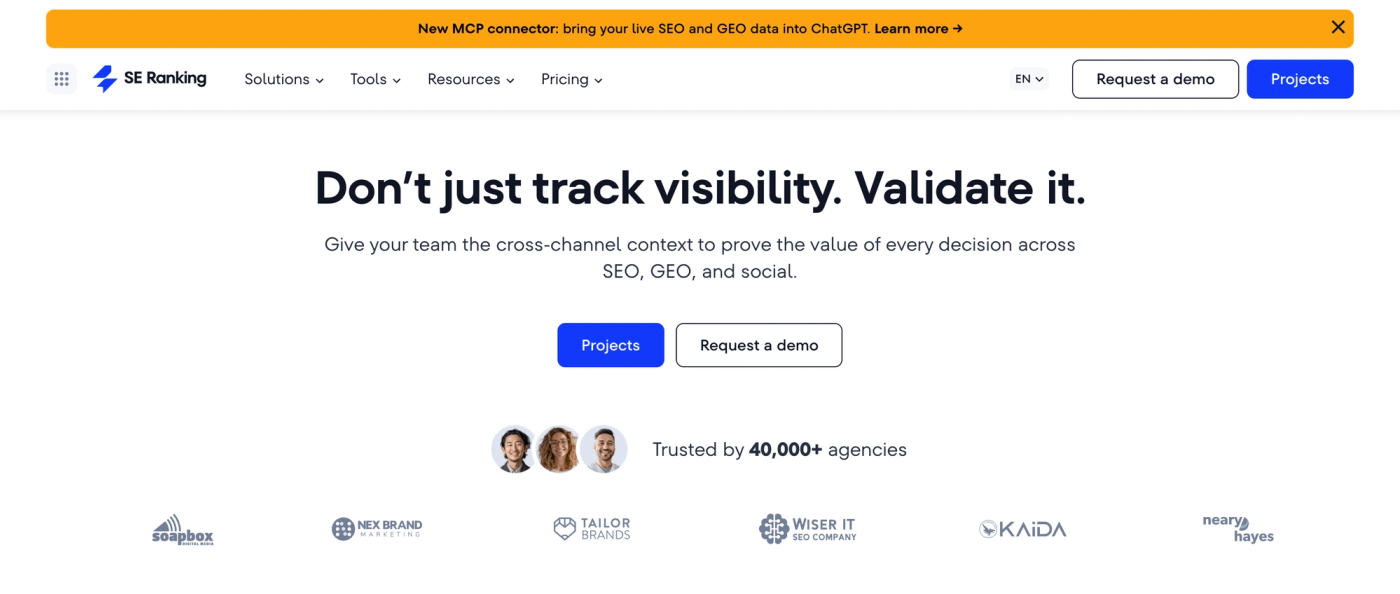
SE Ranking is the tool I keep recommending to teams who need serious SEO capability without committing to a $60,000-plus annual contract.
The UI is the first thing you notice. Clean, intuitive, and fast in a way that most tools in this space simply aren't. Where Semrush can feel like you're navigating a crowded dashboard and Ahrefs rewards power users, SE Ranking gets you to the data you need without friction. For teams that need to onboard non-technical stakeholders quickly, this is consistently where I land.
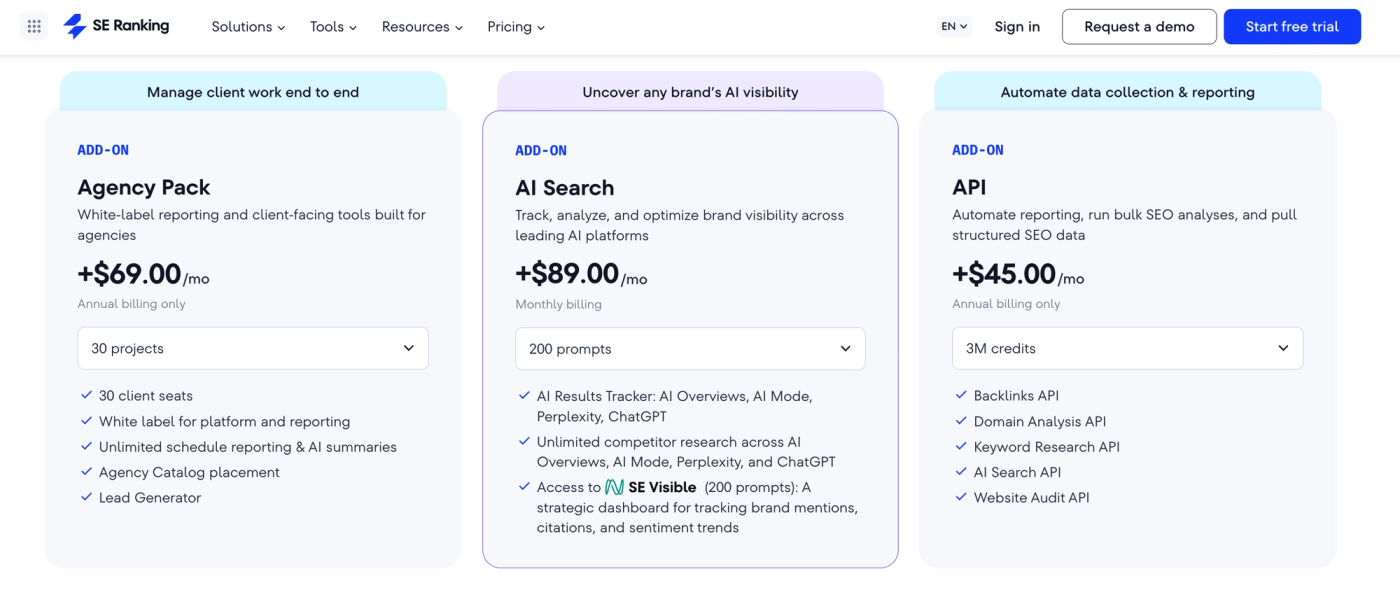
In 2026, SE Ranking made a meaningful step forward on AI visibility. It now monitors your brand across five AI platforms (Google AI Overviews, AI Mode, ChatGPT, Gemini, and Perplexity) in a single connected view, without requiring a separate add-on. That's a feature set you'd normally pay five figures a year for on BrightEdge or Conductor. (Related: 8 Best AI SEO Tools for 2026, if AI visibility is your main focus.)
On pricing, note that SE Ranking retired its old Essential/Pro/Business tiers in late 2025. The current plans are Core (around $129 per month, or $103 on annual billing) and Growth (around $279 per month), both scaling by keyword volume and check frequency. The AI visibility tracking is included, which is the part that genuinely surprises people when they compare it against what the enterprise platforms charge for the same capability. For smaller operations that don't need enterprise scale at all, it's also my value pick lower down the market. (Related: 11 Best SEO Software for Small Businesses.)
SE Ranking isn't a full enterprise platform in the BrightEdge sense. It won't handle multi-domain governance across 50 regions or produce executive dashboards that justify a seven-figure SEO budget to a board. But for agencies, growth-stage companies, and in-house teams who want comprehensive SEO plus AI visibility without a procurement process, it's the best value on this list.
Stack fit: Core platform (Layer 1). Pair with Clearscope or Surfer SEO for content optimization and Screaming Frog for technical auditing.
Key features:
- AI search visibility tracking across five platforms: Google AI Overviews, AI Mode, ChatGPT, Gemini, and Perplexity, built in without an add-on
- Keyword research, rank tracking, and site auditing in one platform
- White-label reporting on the Growth plan and above
- Competitive analysis and SERP feature tracking
- Website audit with 130+ checks and prioritized issue scoring
- API access on the Growth plan
Pros:
- Best UI in its price category by a significant margin
- AI visibility tracking across five platforms is native, not a paid add-on
- Accessible for non-technical team members from day one
- Plans are genuinely affordable for growth-stage companies
- White-label reporting makes it strong for agencies
Cons:
- Backlink database smaller and less frequently updated than Ahrefs
- Not designed for sites with millions of pages
- Lacks enterprise governance features (SSO, SOC 2, multi-region dashboards) that larger organizations require
- Log file analysis not available
Pricing:
- Core: ~$129/month (~$103/month billed annually)
- Growth: ~$279/month
- Both plans scale by keyword volume and check frequency
- AI visibility tracking across five platforms included on every plan
- Annual billing discounts available
Luc's Score: 8.1/10
| Criteria | Score |
|---|---|
| Ease of use & team adoption | 10/10 |
| Technical SEO depth | 7/10 |
| Keyword & competitive intelligence | 8/10 |
| AI/GEO/AEO capabilities | 8/10 |
| Reporting & executive dashboards | 7/10 |
| Integrations | 7/10 |
| Value for money | 10/10 |
| Overall | 8.1/10 |
4. BrightEdge
Best for: Fortune 500 teams justifying SEO budget to executives (Layer 1)
Full disclosure: I haven't used BrightEdge beyond a basic exploration. This review is based on G2 enterprise reviews, Gartner Peer Insights, and verified contract data from Vendr and SpendHound.
BrightEdge has held the position as the default enterprise SEO platform for Fortune 500 teams for years. In 2026, it holds that position for one specific reason: no other platform connects SEO performance to executive-level business outcomes as clearly.
The DataCube reads keyword demand across 90+ countries simultaneously and models the total addressable market in search across aggressive, medium, and conservative scenarios. ContentIQ audits millions of pages and surfaces technical issues prioritized by revenue impact rather than severity. And the AI Catalyst product monitors AI Overview appearances with hourly updates. That's a depth of AI search tracking no other platform in this category currently matches.
That last point matters. Only 17% of sources cited in AI Overviews overlap with the traditional top 10 organic results. If you're managing SEO for a brand where that 83% gap represents real revenue, having hourly visibility into it is worth a lot.
The price reflects all of this. The median annual contract sits at $51,294 (Vendr data). Full enterprise deployments typically run $127,000 to $200,000 or more, and prices have increased 14.49% year-over-year. G2 reviewers consistently flag the learning curve and dated interface as genuine frustrations. Implementation takes one to two months before teams see full value.
BrightEdge is worth it when organic search drives multi-million dollar revenue and you need a platform that can prove it to leadership. It's not worth it below that scale. For instance, Monday.com or HubSpot would value something
Stack fit: Full enterprise platform (Layer 1, with some Layer 2 capability through content recommendations). Still needs to be paired with Screaming Frog for forensic technical auditing.
Key features:
- DataCube: competitive keyword intelligence across 90+ countries with revenue forecasting models
- ContentIQ: large-scale site auditing with revenue impact prioritization
- AI Catalyst: hourly AI Overview monitoring and optimization recommendations
- StoryBuilder and Anomaly Detection: executive-ready narrative reporting
- Integration with GA4, Salesforce, Tableau, and major CMS platforms
Pros:
- Best executive reporting in the enterprise SEO category
- Deepest AI Overview tracking of any full-suite platform (hourly updates)
- Global scale: built for multi-domain, multi-region programs
- Strong customer success support at enterprise tier
Cons:
- Median contract $51K/year; full enterprise often $127K to $200K+
- Price increasing 14.49% year-over-year
- Interface described by multiple G2 reviewers as outdated and hard to navigate
- Implementation typically takes one to two months before value is realized
Pricing:
- Custom enterprise pricing only
- Median annual contract: ~$51,294 (Vendr data)
- Full enterprise: typically $127,000 to $200,000+
- Contact BrightEdge for a quote
Luc's Score: 7.9/10
| Criteria | Score |
|---|---|
| Ease of use & team adoption | 5/10 |
| Technical SEO depth | 9/10 |
| Keyword & competitive intelligence | 9/10 |
| AI/GEO/AEO capabilities | 9/10 |
| Reporting & executive dashboards | 10/10 |
| Integrations | 8/10 |
| Value for money | 5/10 |
| Overall | 7.9/10 |
5. Conductor
Best for: Content-driven enterprise teams building for AI search (Layer 1)
Full disclosure: Not based on personal hands-on use. Based on G2 enterprise reviews, Gartner Peer Insights, and published platform documentation.
Conductor markets itself as the only end-to-end enterprise AEO platform. In 2026, that's a defensible claim. They've built AI visibility into the core workflow rather than offering it as an add-on, which puts them ahead of most traditional enterprise platforms on this specific dimension.
The ContentKing integration gives Conductor real-time site monitoring with no page limits. The AI Insight Engine tracks which content is being cited by ChatGPT, Gemini, and other AI platforms, then surfaces semantic gaps your team can act on. The MCP integration lets teams query Conductor's SEO and AEO intelligence directly from within AI tools, which is useful for large editorial teams that have started building AI into their production workflow.
Where Conductor consistently wins evaluations over BrightEdge is team workflows. It's built around collaboration: content briefs, approval workflows, cross-team dashboards. For content-led organizations where multiple people need to act on SEO insights rather than just read reports, that collaboration layer is genuinely valuable.
Where it consistently loses is implementation. G2 reviews flag onboarding complexity and customer rep turnover as recurring frustrations. Full deployments take one to two months, and teams without a dedicated SEO owner regularly report using a fraction of what they're paying for.
One stat worth flagging: Conductor's own survey reports that 94% of enterprises plan to increase AEO/GEO investment in 2026. That's an impressive number, but it comes from Conductor themselves, so weight it accordingly.
Stack fit: Full enterprise platform (Layer 1, with built-in content brief capabilities that partially cover Layer 2). Still benefits from Screaming Frog for forensic technical work.
Key features:
- ContentKing integration: real-time monitoring with no page crawl limits
- AI Insight Engine: citation tracking across ChatGPT, Gemini, and Perplexity
- MCP integration: query SEO and AEO intelligence directly inside AI tools
- Content workflow and brief creation tools for large editorial teams
- Cross-regional and multi-brand governance for global organizations
Pros:
- Most complete AEO workflow integration in any full-suite platform currently available
- ContentKing's real-time monitoring removes page limits that frustrate teams on other platforms
- Content collaboration tools built for the way large editorial teams actually work
- Strong for global multi-brand enterprises standardizing SEO across regions
Cons:
- Onboarding complexity is a consistent theme in G2 reviews
- Customer rep turnover frustrates long-term users
- Not suitable for organizations below roughly $50M revenue
- $60K+ minimum with a complex enterprise sales process
Pricing:
- Custom enterprise pricing only
- Typically $60,000 to $300,000+ annually
- Full deployments require one to two months before value is realized
- Contact Conductor for a quote
Luc's Score: 7.7/10
| Criteria | Score |
|---|---|
| Ease of use & team adoption | 7/10 |
| Technical SEO depth | 8/10 |
| Keyword & competitive intelligence | 8/10 |
| AI/GEO/AEO capabilities | 9/10 |
| Reporting & executive dashboards | 8/10 |
| Integrations | 9/10 |
| Value for money | 5/10 |
| Overall | 7.7/10 |
6. seoClarity
Best for: Data-heavy teams who've outgrown keyword limits on other platforms (Layer 1)
Full disclosure: Not based on personal hands-on use. Based on G2 enterprise reviews, the 2025 Forrester Wave, and platform documentation.
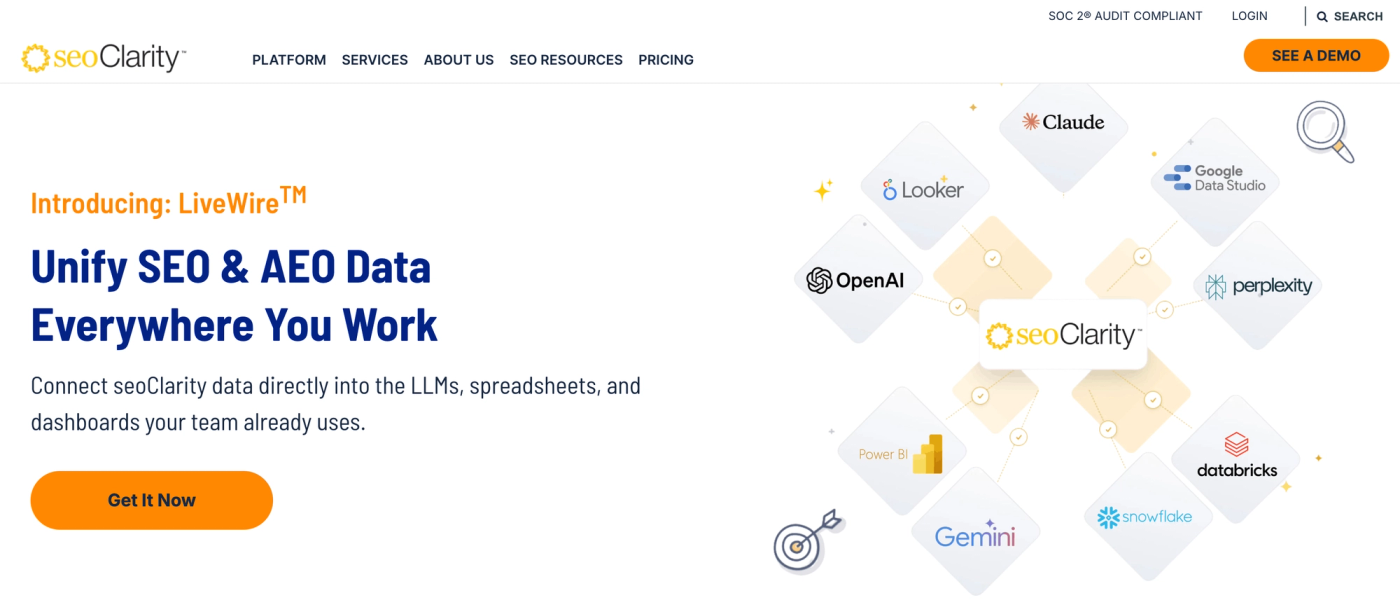
seoClarity's headline differentiator is simple: unlimited keyword tracking within your subscription tier. No per-keyword fees at the margin. No surprise overages as your program scales. One senior SEO content manager on a verified review put it directly: "Unlike Ahrefs and Semrush, there aren't silly low limits on exports in seoClarity." For enterprise teams managing tens of thousands of keywords across multiple domains, that structural difference alone can justify the switch.
The Clarity Grid processes data across a proprietary index of 32+ billion keyword terms across 90+ countries. Sia, seoClarity's AI engine, surfaces automated recommendations across technical SEO, content, and competitor gaps, prioritized by projected traffic impact. The no-limits crawler audits up to 20 million pages per month. And onboarding is two business days to initial access, one of the fastest timelines in this category.
The tradeoffs are real and public. seoClarity scored 2.9 out of 5 in the 2025 Forrester Wave, the lowest score of any platform in this review. The interface is complex. Country coverage for research is narrower than BrightEdge (under 25 countries versus 90+). Multiple users describe a steep learning curve that requires sustained investment before the platform pays for itself.
Pricing starts at $3,600 per month for one domain, or $4,500 per month for multiple domains, putting the floor at $43,200 to $54,000 per year before add-ons.
Stack fit: Full enterprise platform (Layer 1, with Content Fusion covering some Layer 2 content optimization). Pair with Screaming Frog for on-demand forensic auditing.
Key features:
- Unlimited keyword tracking within subscription tier, no per-keyword overage fees
- Clarity Grid: 32+ billion keyword terms across 90+ countries
- Sia AI engine: automated recommendations prioritized by projected traffic impact
- No-limits crawler: up to 20 million pages per month
- Content Fusion: AI-assisted content optimization in 16 languages
- Clarity360: connects crawl data, indexation, rankings, traffic, and conversions in one view
Pros:
- Unlimited keyword tracking removes the scaling bottleneck every large team hits on standard platforms
- Fastest enterprise onboarding in this category: two business days to access
- Strong BI integrations for teams with existing data warehouse infrastructure
- Comprehensive multi-site and multi-region capability
Cons:
- 2.9/5 in the 2025 Forrester Wave
- Complex interface with a steep learning curve
- Country coverage for research narrower than BrightEdge
- Requires dedicated SEO ownership to extract full value
Pricing:
- $3,600/month for one domain ($43,200/year)
- $4,500/month for multiple domains ($54,000/year)
- Add-ons and larger keyword sets push costs higher
- Annual contracts are standard
Luc's Score: 7.4/10
| Criteria | Score |
|---|---|
| Ease of use & team adoption | 5/10 |
| Technical SEO depth | 9/10 |
| Keyword & competitive intelligence | 9/10 |
| AI/GEO/AEO capabilities | 7/10 |
| Reporting & executive dashboards | 8/10 |
| Integrations | 8/10 |
| Value for money | 6/10 |
| Overall | 7.4/10 |
7. Screaming Frog
Best for: Technical SEO audits (every enterprise team, no exceptions) (Layer 3)
Let me be direct about this one.
You're not deciding whether to use Screaming Frog. You're deciding what to use it alongside.
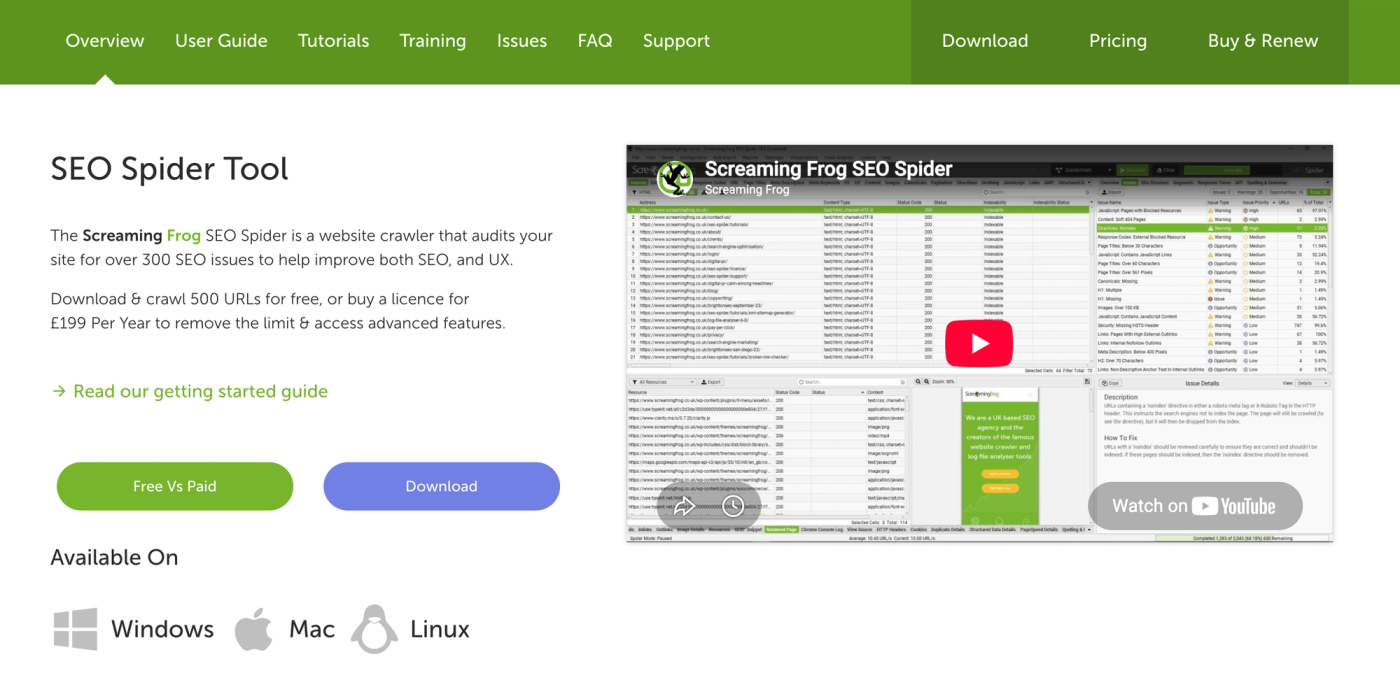
Every enterprise SEO team I've encountered has a Screaming Frog license. The price is $259 per year. No enterprise platform in this category replaces what it does for forensic technical audits, site migrations, and on-demand crawls.
Nick Eubanks, founder of From the Future and one of the most respected technical SEO operators in the US, puts it plainly: "When it comes to enterprise SEO, it all starts with the basics; a great, scalable, reliable crawler and log file analyzer."
Screaming Frog has been the standard desktop crawler since 2010. In 2026, it added native AI integrations with OpenAI, Anthropic, and Gemini, meaning you can now run AI classification and extraction tasks directly during the crawl. You can pull structured data from any page element, classify content types, flag issues by business impact, and export everything in a format your engineering team can act on.
The limitations are worth knowing upfront. It's a desktop application, so hardware is the ceiling on crawl speed. It doesn't monitor your site continuously and won't alert you when something breaks between crawls. It requires technical SEO literacy to configure properly. For continuous monitoring at scale, you pair it with something else (Lumar, Botify, or ContentKing inside Conductor). For the actual forensic audit work, nothing replaces it.
The verdict: buy it. Learn it. Use it on every significant crawl and every migration. It's $259 a year.
Stack fit: Technical crawler (Layer 3). Works alongside any Layer 1 platform. (Related: Best White Label SEO Tools, if you're an agency reporting to clients.)
Key features:
- Crawls 300+ technical SEO checks across any site
- JavaScript rendering via Chrome
- Native AI integrations with OpenAI, Anthropic, and Gemini for in-crawl analysis and classification
- Google Analytics and Search Console integration for enriched crawl data
- Custom data extraction via XPath and CSS selectors
- Redirect chain visualization and hreflang auditing
- Scheduled crawls with automated Google Sheets export
Pros:
- $259 per year: the best value on this entire list, by an enormous margin
- AI-integrated crawl analysis is a genuinely new capability in 2026 that larger platforms don't replicate for on-demand work
- No page limit on the paid license
- Desktop-based means data stays local, which matters in security-conscious environments
- Indispensable for site migrations; nothing else validates redirects this reliably
Cons:
- Desktop-based: crawl speed is limited by local hardware
- Not a monitoring tool; won't catch regressions between scheduled crawls
- Requires technical SEO knowledge to configure and interpret effectively
- Free version capped at 500 URLs
Pricing:
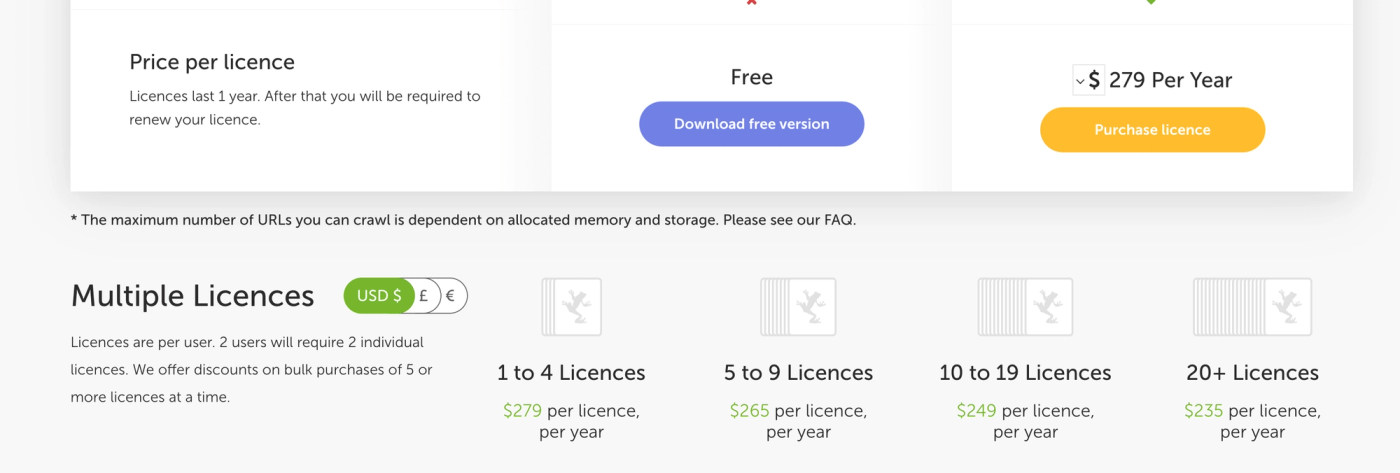
- Free: up to 500 URLs
- Paid: £199/year (approximately $259 USD)
Luc's Score: 6.6/10
| Criteria | Score |
|---|---|
| Ease of use & team adoption | 6/10 |
| Technical SEO depth | 10/10 |
| Keyword & competitive intelligence | 3/10 |
| AI/GEO/AEO capabilities | 5/10 |
| Reporting & executive dashboards | 5/10 |
| Integrations | 7/10 |
| Value for money | 10/10 |
| Overall | 6.6/10 |
The overall score is low because the rubric covers all seven criteria, including keyword intelligence and executive reporting that Screaming Frog isn't designed for. On its actual job (forensic technical auditing) it's a 10/10. Use the number when comparing it against all-in-one platforms. Use the context when deciding whether to buy it.
8. Botify
Best for: Sites with 500,000+ pages where crawl budget is genuinely a bottleneck (Layer 3)
Full disclosure: Not based on personal hands-on use. Based on G2 reviews, published documentation, and industry pricing data.
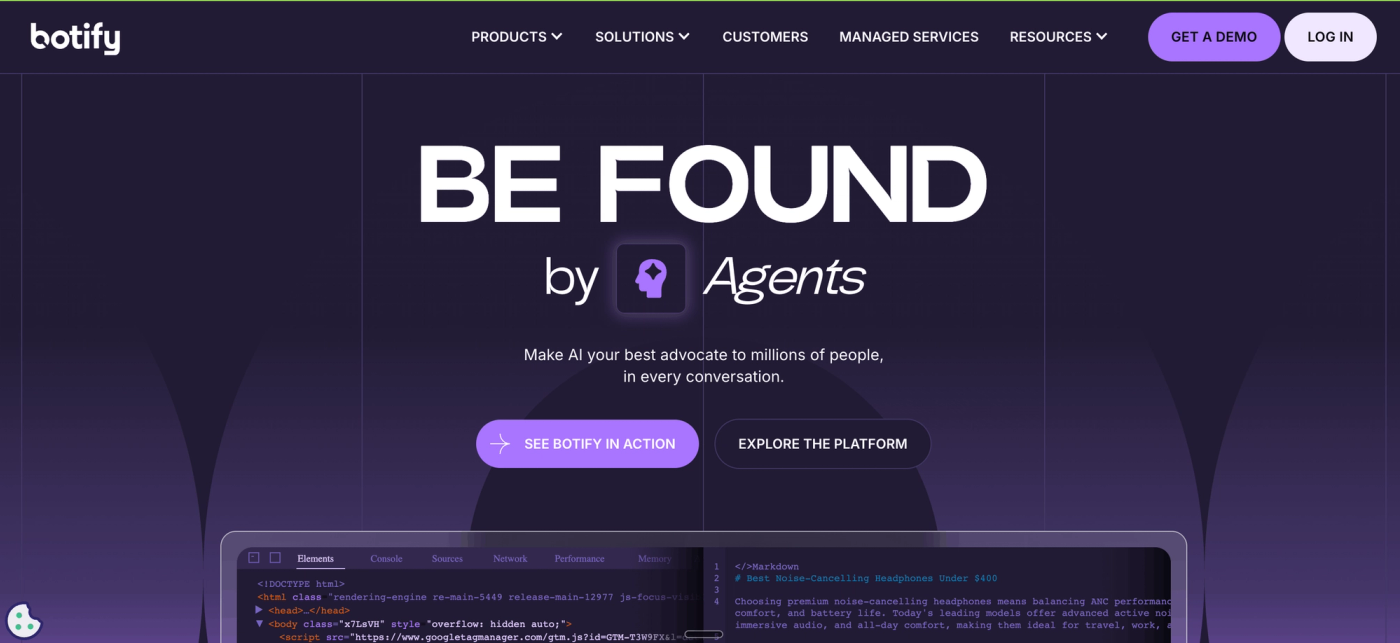
Botify is not a tool you evaluate casually. There's no free trial, no self-serve signup, and no published pricing. That tells you exactly who it's built for: enterprise teams with serious crawl problems and budgets to match.
The core insight behind Botify's methodology is that 50% of large site content never gets crawled by Google at all, based on Botify's own research across their customer base. If your team is publishing content and wondering why it's not being indexed, that's usually where the problem lives. Log file analysis is the only reliable way to see it, and Botify's log file integration is the deepest in any single platform.
The crawl speed is 450 URLs per second for standard content, 350 URLs per second for JavaScript-rendered pages. For e-commerce sites with millions of product pages or media companies with years of archived content, that processing capacity matters. In 2026, Botify also added AI search visibility tracking across ChatGPT, Perplexity, and Google AI Mode, adding AEO monitoring to what was previously a pure technical platform.
The honest caveat: Botify is overkill for anything under 500,000 pages. Screaming Frog at $259 per year handles technical crawling for 90% of sites. Botify also requires a dedicated technical SEO owner with engineering support to translate what it surfaces into actual fixes. Without that, you'll use a fraction of a very expensive platform.
Pricing starts at $75,000 to $150,000 per year for mid-sized enterprise deployments, with large implementations reaching $400,000 or more.
Stack fit: Technical crawler (Layer 3). Not a standalone; always paired with a Layer 1 core platform for keyword research and backlink analysis.
Key features:
- Log file analysis: understand exactly how Googlebot allocates crawl budget across your site
- 450 URLs/second crawl speed (350 for JavaScript-rendered pages)
- AI search visibility tracking: ChatGPT, Perplexity, and Google AI Mode added in 2026
- Crawl budget optimization for large, complex site architectures
- Automated sitemap generation and 404 monitoring
- Integrations with data warehouses and BI platforms
Pros:
- Log file analysis at this depth is unique on this list
- Built for e-commerce and media sites with 500K+ pages
- Crawl speed and JavaScript rendering are best-in-class
- AI search tracking expanded the platform's scope significantly in 2026
Cons:
- Starts at $75K/year with no free trial and no self-serve access
- Requires dedicated technical SEO ownership plus engineering resources to act on findings
- Not an all-in-one: needs to be paired with another platform for keyword research and backlink analysis
- Large enterprise implementations can exceed $400,000/year
Pricing:
- Custom enterprise pricing only
- Mid-sized deployments: approximately $75,000 to $150,000/year
- Large enterprise: $400,000+/year
- Annual contracts, typically 12 to 36 months
Luc's Score: 6.4/10
| Criteria | Score |
|---|---|
| Ease of use & team adoption | 4/10 |
| Technical SEO depth | 10/10 |
| Keyword & competitive intelligence | 5/10 |
| AI/GEO/AEO capabilities | 7/10 |
| Reporting & executive dashboards | 7/10 |
| Integrations | 8/10 |
| Value for money | 4/10 |
| Overall | 6.4/10 |
9. Lumar (formerly DeepCrawl)
Best for: Cloud-based enterprise crawling with CI/CD pipeline integration (Layer 3)
Full disclosure: Not based on personal hands-on use. Based on G2 reviews, industry documentation, and pricing data.
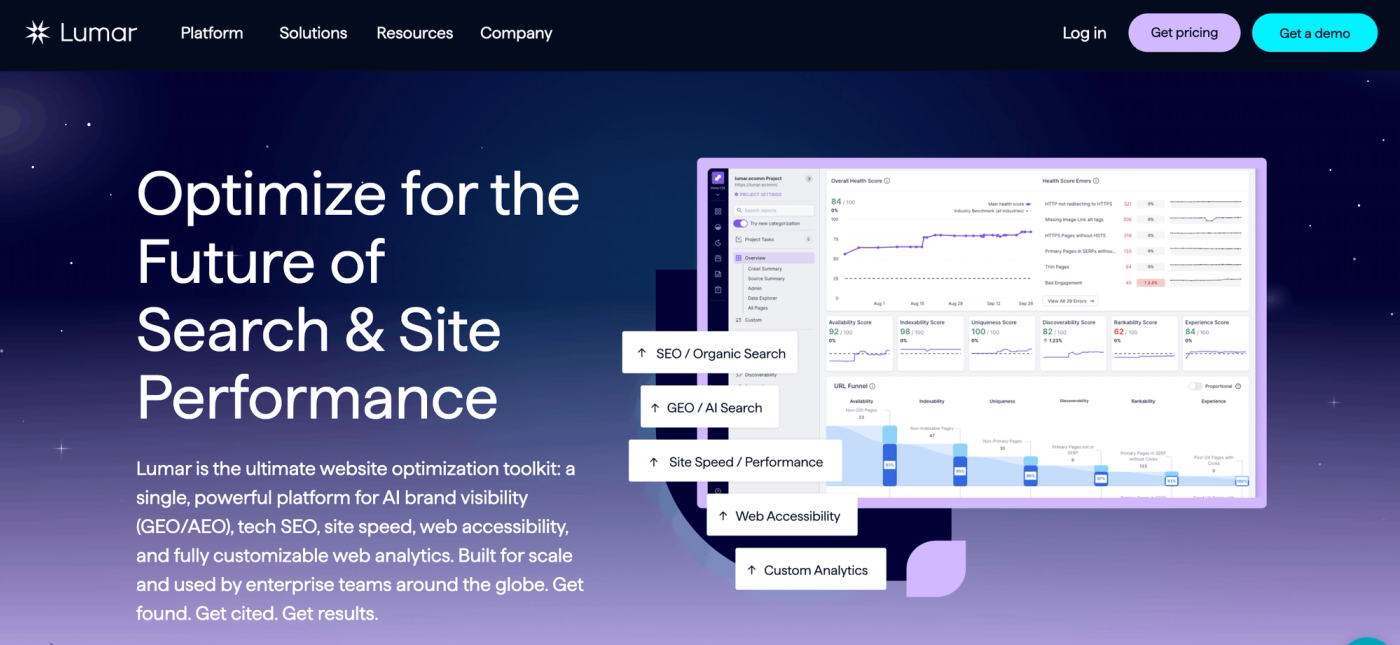
Lumar is the cloud-based answer to the question Screaming Frog can't solve at scale: continuous monitoring across millions of pages without needing a local machine to run it.
Originally known as DeepCrawl, Lumar rebranded in 2022 to reflect an expansion from pure SEO crawling into site speed, accessibility, and AI visibility. The platform now runs four modules: Analyze (comprehensive technical SEO), Monitor (continuous site health), Protect (automated QA in CI/CD pipelines), and Impact (business impact measurement).
Protect is the differentiator. It integrates directly with CI/CD pipelines so that when engineering deploys a new build, Lumar runs 350+ automated tests before anything reaches production. A missed canonical tag or broken redirect hitting millions of pages overnight can cost far more than the annual contract. For enterprises running frequent deploys on complex sites, that pre-deploy catch is the specific problem Lumar is built to solve.
The performance is serious: 450 URLs per second for standard content, 350 for JavaScript. SOC 2 Type II compliance makes it viable for finance and healthcare organizations where other platforms get ruled out on security grounds.
The honest limitation: this is the right tool for a narrow but important use case. Sites under 500,000 pages don't need it. Teams without engineering resources to act on the findings won't extract full value. And Lumar doesn't cover keyword research or backlinks, so it always lives alongside another platform, not instead of one.
Pricing typically starts at $12,000 to $32,000 per year, with enterprise deployments running $100,000 or more.
Stack fit: Technical crawler (Layer 3). Always paired with a Layer 1 core platform.
Key features:
- Cloud crawler: 450 URLs/second (350 for JavaScript)
- Monitor module: continuous site health with custom alerting thresholds
- Protect module: CI/CD pipeline integration that catches SEO regressions before deployment
- 350+ built-in automated tests across technical SEO, site speed, and accessibility
- WCAG 2.2 accessibility compliance testing built in
- SOC 2 Type II compliant
- GraphQL API for custom integrations with data warehouses
Pros:
- CI/CD integration is genuinely unique on this list and valuable for engineering-led teams
- SOC 2 compliance opens it up to regulated industries that rule out competitors
- WCAG accessibility testing alongside SEO is an unusual and useful combination
- Cloud-based: no hardware limits, scales to millions of pages without local machine constraints
Cons:
- Expensive relative to what it specifically covers ($12K-$32K+ base, $100K+ enterprise)
- No keyword research or backlink data: always needs to be paired with another platform
- No free trial; demo-only access
- Overkill for sites under 500,000 pages
Pricing:
- Custom enterprise pricing only
- Entry-level contracts: approximately $12,000 to $32,000/year
- Enterprise deployments: $100,000+/year
- Contact Lumar for a quote
Luc's Score: 6.4/10
| Criteria | Score |
|---|---|
| Ease of use & team adoption | 6/10 |
| Technical SEO depth | 10/10 |
| Keyword & competitive intelligence | 2/10 |
| AI/GEO/AEO capabilities | 6/10 |
| Reporting & executive dashboards | 7/10 |
| Integrations | 9/10 |
| Value for money | 5/10 |
| Overall | 6.4/10 |
Pricing Snapshot
| Tool | Free Tier | Entry Price | Notes |
|---|---|---|---|
| SE Ranking | No | ~$129/month | Core plan; AI visibility across 5 platforms included |
| Ahrefs | Yes (verified sites) | $29/month | Enterprise $1,499/month; avg ~$11,800/year after negotiation |
| Semrush | Limited | $139.95/month | Enterprise avg ~$18,240/year; watch add-on costs |
| BrightEdge | No | ~$51K/year median | Custom enterprise; prices rising 14.49% YoY |
| Conductor | No | ~$60K+/year | Custom enterprise; 1-2 month implementation |
| seoClarity | No | $3,600/month | ~$43K/year for one domain; 2-day onboarding |
| Screaming Frog | Yes (500 URLs) | £199/year (~$259 USD) | Best value on this list |
| Botify | No | ~$75K/year | No trial; requires engineering resources |
| Lumar | No | ~$12K-$32K/year | Custom; always paired with another platform |
How to Build Your Enterprise SEO Stack
The best enterprise SEO programs don't run on one platform. They run on a three-layer stack, and the specific tools you choose within each layer depend on the problem you're actually trying to solve.
If your biggest problem is competitive intelligence and keyword data: Ahrefs (Layer 1) plus Screaming Frog (Layer 3) plus Clearscope or Surfer SEO (Layer 2 for content teams). Strong foundation for under $20,000 per year that covers most of what enterprise platforms handle.
If your biggest problem is content velocity at scale: Semrush or Conductor (Layer 1) gives you the research layer, but you'll still want Clearscope or Surfer SEO (Layer 2) sitting alongside it for the actual content optimization work. Semrush's content tools help; they don't replace a dedicated tool.
If your biggest problem is getting SEO budget approved and proving revenue impact: BrightEdge or Conductor (Layer 1). Budget $60,000 to $150,000 or more annually, and plan for a dedicated SEO platform owner or you'll underuse it. Pair with Screaming Frog for forensic technical work.
If your biggest problem is AI search visibility without an enterprise contract: SE Ranking (Layer 1) handles keyword research, rank tracking, site auditing, and AI visibility across five platforms for a few thousand dollars a year, not a six-figure contract. Add Clearscope or Surfer SEO for content and Screaming Frog for technical.
If your biggest problem is a site with millions of pages that Google isn't fully crawling: Botify or Lumar (Layer 3) alongside your existing Layer 1 platform. These are additive specialist tools, not replacements for your core stack.
Methodology
I've been doing SEO for over a decade, across personal projects, client work, and senior in-house growth roles. I co-founded Ticker Nerd, an investing newsletter that was acquired by a FinTech company, where SEO was a core acquisition channel from day one. I'm currently Head of Growth (APAC) at Rippling, where I manage SEO as part of a broader demand generation and GTM function. That's the context I'm evaluating these tools from: not as a reviewer who signed up for a trial, but as someone who has to make real decisions about what's worth the budget and what isn't.
For this guide, I drew on four main sources.
Direct experience: Ahrefs, Semrush, SE Ranking, and Screaming Frog are tools I use personally and regularly. Those entries reflect real usage, not feature lists.
Market research and verified third-party data: For BrightEdge, Conductor, seoClarity, Botify, and Lumar, I reviewed G2 enterprise category reviews, Gartner Peer Insights ratings, the 2025 Forrester Wave for Enterprise SEO Platforms, and anonymized real contract pricing from Vendr and SpendHound. I flag this distinction in each entry.
Scoring consistency: Every tool was scored against the same seven-criteria rubric. Criteria and weights did not change mid-evaluation. Where a tool scores low on criteria outside its design scope (Screaming Frog on executive reporting, Botify on keyword intelligence), I note the context rather than inflating the score.
No paid placements: Tools are ordered by score and use case fit, not by affiliate commission rate. Affiliate links are disclosed at the top of this article.
Frequently Asked Questions
What's the difference between enterprise SEO tools and regular SEO tools?
Enterprise tools are built for scale, collaboration, and governance. That means crawling millions of pages, supporting multiple users with role-based permissions, connecting SEO data to revenue in executive dashboards, and in 2026, tracking AI search visibility across ChatGPT, Perplexity, and Google AI Overviews. Standard tools are built for individual practitioners or small teams. The enterprise versions of those same tools add the collaboration, governance, and scale layers.
Do I really need a full tool stack, or can one platform cover everything?
You need a stack. No single platform covers all three layers well enough to replace the others. In practice, even teams on $150,000-per-year BrightEdge contracts still run Screaming Frog for forensic technical work. A realistic enterprise SEO stack includes a core SEO platform (keyword research, competitive intelligence, rank tracking), a content optimization tool (Clearscope or Surfer SEO for brief creation and optimization scoring), and a technical crawler (Screaming Frog for all teams; Botify or Lumar for sites with 500K+ pages).
How much do enterprise SEO platforms actually cost?
Screaming Frog is $259 per year. SE Ranking starts at around $129 per month (Core). Semrush Business is $499.95 per month. True enterprise platforms (BrightEdge, Conductor, seoClarity, Botify, Lumar) run custom contracts typically between $43,000 and $300,000+ per year. Most require annual commitments. Buyers who arrive with competitive quotes and real benchmark data consistently pay below the opening price on the major platforms.
What is GEO and AEO, and which tools track it?
GEO (Generative Engine Optimization) is optimizing content so AI platforms like ChatGPT and Perplexity cite it in their responses. AEO (Answer Engine Optimization) is structuring content to appear in AI-generated direct answers, including Google AI Overviews. Tools with meaningful coverage in 2026: BrightEdge (hourly AI Catalyst monitoring), Conductor (AI Insight Engine), SE Ranking (native, five platforms), Semrush One (bundled), and Botify (added 2026). Tools without strong AEO coverage: seoClarity (emerging), Screaming Frog and Lumar (technical crawlers, not AI visibility trackers).
Which enterprise SEO tool is best for a team without in-house technical SEO?
SE Ranking. Best UI in its category, covers keyword research, site auditing, rank tracking, and AI visibility without requiring a technical SEO specialist to extract value from day one. Semrush is a close second on breadth. The pure enterprise platforms (BrightEdge, Conductor, seoClarity, Botify) all reward dedicated ownership and consistently underdeliver for teams without it.
Related Articles
Last updated: July 2026 | Prices last checked: July 2026
Keep reading