How to Get Cited in AI Search: My Personal Playbook
 Luciano Viterale
 On this page
Everyone talks about ranking in AI search like it's a dark art.
Some proprietary secret sauce you have to reverse-engineer from scratch.
It isn't.
It's a repeatable playbook, and most of it is work you already know how to do.
It matters more every month. Around 68% of Google searches now end without a click.
AI Overviews keep expanding fast, and a growing share of buyers are asking ChatGPT, Claude, and Perplexity for recommendations before they ever touch a traditional search box. If the model doesn't mention you, you're invisible at the exact moment someone is choosing who to go with.
I basically do this for a living now, through my AI SEO & AEO consulting work. I run this playbook on my own site, on my business Stacked Finance for asset finance terms, for my mortgage broker and partner brokers like AFMS Group, and in-house at Rippling.
With AFMS Group, it’s easily driven $50k+ in referral commissions that traced back to ChatGPT alone. It works, and I'm going to keep doing it.
Most "how to rank in AI search" guides just rehash on-page SEO and tell you to write great content. That's not wrong, but it isn't the method. Here's the actual playbook, in the order I run it.
What you'll need
You don't need a special tool to start. You need:
- One or two of the big models to do recon: ChatGPT, Claude, Gemini, and Perplexity. The free tiers are fine.
- Your normal SEO foundation, in progress. More on that in step one.
- A short list of the queries you actually want to win, the ones a buyer would type when they're ready to choose.
That's the whole kit. The work is manual, and that's exactly why most people never do it.
The core insight: models recommend what the web already vouches for
Here's the thing that makes all of this make sense. Large language models don't pull recommendations out of thin air. They lean on the sources the wider web already trusts: roundup and "best of" articles, reviews, community discussion like Reddit, and your own site's authority and language.
So getting cited is not magic. It's manufacturing the evidence the model reads. You get into the sources it already quotes, and you make your own brand's footprint clean and consistent enough that the model repeats it. Everything below is a way of doing that.
Step 1: Get the boring SEO fundamentals right first
There's no shortcut around this. Before any of the AI-specific plays land, you need the basics in place: a solid website, real backlinks, brand mentions, genuinely high-quality content, a domain rating that's trending up, actual rankings for terms that matter, clear product or service pages, case studies, and reviews.
Try not to skip this. Even though it takes time.
Why it matters: the models draw on the same signals the rest of search does. If nothing on the open web establishes that you exist and that you're credible, there's nothing for an answer engine to cite. The fundamentals are the raw material everything else feeds on.
If you want the toolkit I actually use for this foundation work, I've covered it in best DIY SEO software.
The failure mode here is trying to hack citations with no authority underneath. It doesn't work. Do the unglamorous part first.
Step 2: Find out what the models actually cite
This is the step almost nobody does properly, and it's the whole play. Take the queries you want to win and run them across the models yourself. Not once, and not in only one engine.

Type "best mortgage brokers," or "best 7 mortgage brokers," or "best 10 email marketing agencies," whatever the version is for your business.
Then read what comes back and note which specific articles and sites the model pulls from. Do it in ChatGPT, then Claude, then Gemini, then Perplexity, because they cite different sources.
You now have a target list: the exact roundups and pages that are feeding the answer you want to be part of. Everything from here is about getting into that list.
The failure mode is guessing instead of looking, or checking one engine and assuming the rest behave the same. They don't.
Step 3: Win the listicle game (this is the 80/20)
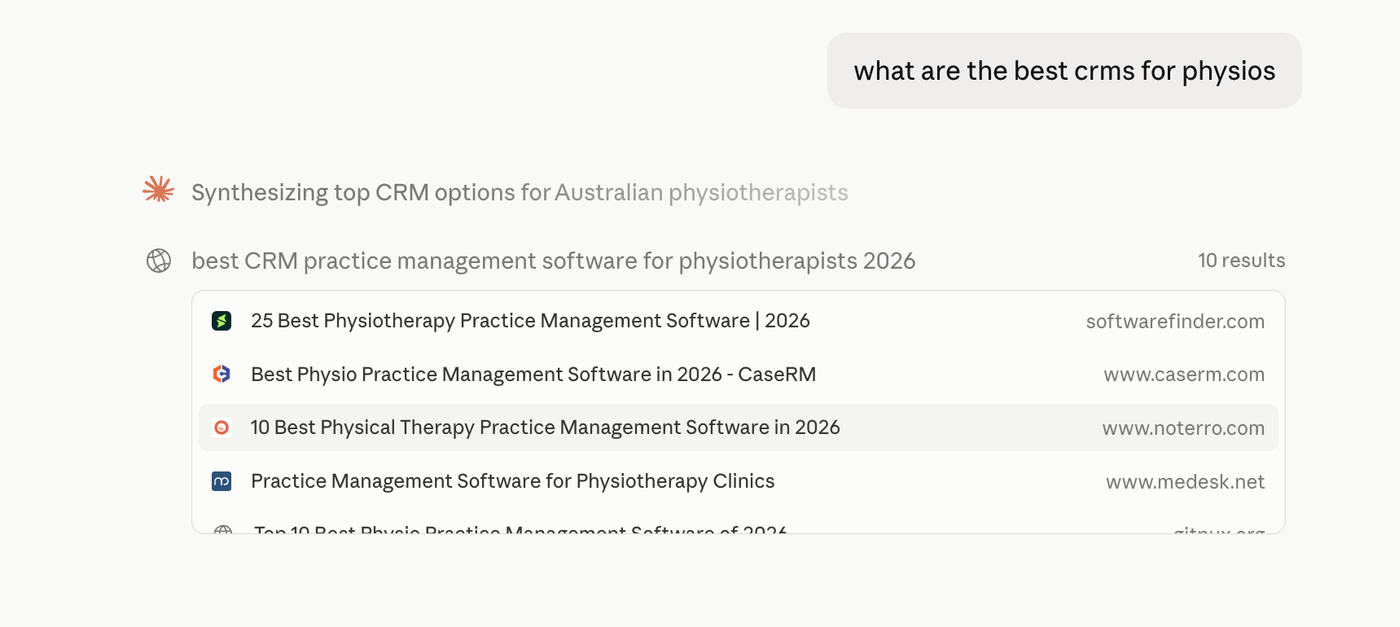
The single highest-leverage move is getting into the "best X" roundups, because that's what the models quote when someone asks for a recommendation. There are two halves to it.
Build your own roundup first. Create the article on your own site: "The 10 Best [service] in [place]." List yourself, or the business you're promoting, as the number one pick, and genuinely cover the others so the piece is actually useful. This gives you a strong, on-topic page that names you as a top option, and that page can get cited in its own right.
Then get onto everyone else's roundups. Use the target list from step two. For each cited roundup that's updatable and has a real author you can reach, pitch to be added. If there aren't good roundups to join, produce a guest post that becomes one.
The pitch doesn't need to be clever, it needs to give them a reason to say yes. For AFMS Group, the outreach was close to: "I run a mortgage brokerage that's a strong fit for your 'best brokers in [city]' list. Here's our review score, a couple of specific client outcomes, and a short blurb you can drop straight in." Concrete, easy to add, no work for them. That's what gets included.
The failure mode is only building your own list and never doing the outreach, or sending generic "please link me" emails with no reason attached.
Step 4: Build up reviews and third-party coverage
Models weigh reviews and independent mentions heavily, so the more credible coverage exists about your business, the more the answer engines have to lean on.
Earn reviews on the platforms that matter, publish real case studies, get covered by relevant publications and partners, and yes, you can just pay other businesses to write reviews about yours. That last one happens far more than anyone admits. The one line I won't cross is faking reviews outright, because that torches trust with customers and platforms the second it's found out. Paid but real is a different thing from invented.
The failure mode is chasing volume with junk. Keep the reviews real, even the paid ones, and they compound.
Step 5: Play Reddit and community threads
Reddit punches far above its weight in AI answers, so it's worth a deliberate play. Write posts about your space where it's genuinely welcome, and find existing threads where people are already discussing your category. Contribute answers that are actually useful, and weave in the specific features or strengths you want your brand to be known for.
It’s fairly simple to research a few relevant queries and drop some comments that mention your brand or product.
Be genuinely helpful and be upfront about who you are. Astroturfing gets caught, removed, and can backfire hard. Useful, honest contributions that happen to mention what you're good at are the ones that stick and get pulled into answers later.
Step 6: Shape how your brand talks about itself
The models repeat the language they find. So give them clean, consistent language to repeat. Tighten your FAQs, blog posts, and product pages so they clearly state what you do, who you're for, and the exact terms you want to be associated with.
If you want to be known for asset finance, or for being the best broker in a specific city, say it plainly and consistently across your own properties. Vague positioning gives the model nothing to grab; specific, repeated positioning gives it a phrase to reach for.
Step 7: Repeat across engines, and go beyond short keywords
Two habits turn this from a one-off into a system.
First, repeat the whole loop across every engine, because a win in ChatGPT is not automatically a win in Perplexity or Gemini. Check each one and close the gaps where you're missing.
Second, go past the short head terms into long, detailed use-case queries. Almost nobody types "best email marketing software" anymore. They describe their whole situation: their team size, their budget, their goals, and then ask what to use. Those long prompts are their own battleground, and they're often less contested than the head terms.
Where the paid tools fit
Everything above is manual, and at small scale manual is fine. The moment you're tracking a lot of queries across four engines, doing the recon by hand gets slow. That's the exact job the paid AI-visibility tools do: they run hundreds of queries across the engines and show you, at a glance, where you're missing and who's being cited instead.
What they don't do is build the roundup, send the outreach, or write the Reddit comment. They automate the finding, not the doing. If you want to see which ones are actually worth paying for and which are wildly overpriced, I've ranked them in best AI SEO tools.
What success looks like
You'll know it's working when your business starts showing up as a recommended option across multiple engines for the queries you targeted, and when that turns into real inquiries. With AFMS Group, showing up in ChatGPT for the right broker queries turned into $50k+ in referral commissions. You want a running target list, a repeatable weekly loop, and a steadily growing share of the answers in your category.
Common mistakes
- Skipping the SEO fundamentals and trying to hack citations with no authority underneath.
- Doing the recon in one engine and assuming the others match.
- Building your own roundup but never doing the outreach to get onto other people's.
- Generic, reason-free outreach that gives editors nothing to say yes to.
- Fake or undisclosed reviews, and spammy Reddit self-promotion that gets removed.
- Treating this as a one-time project instead of a loop you run.
FAQ
How long does it take to show up in ChatGPT?
It depends on your starting authority. If your fundamentals are already decent, getting added to a few cited roundups and building some reviews can move things in weeks. From a standing start, it's months, because the foundation has to come first.
Do I need a paid AI-visibility tool to do this?
No. You can run the entire loop by hand with the free tiers of the models. A paid tool earns its place once doing the recon manually across hundreds of queries eats too many hours. It automates the finding, not the fixing.
Isn't putting yourself number one on your own roundup biased?
Of course it is, and everyone's roundup is. The move is to make the piece genuinely useful and honest about the other options, so it earns its place. A self-serving list that's actually helpful still helps real readers. A dishonest one gets found out.
Does this work for local and service businesses?
Yes. The mortgage broker examples are exactly that. Local "best X in [city]" queries are often less contested and convert hard, because the person asking is ready to choose.
What about Google's AI Overviews versus ChatGPT and Perplexity?
Same playbook, different surface. AI Overviews lean more on classic search signals, so your fundamentals matter even more there, while ChatGPT and Perplexity lean harder on roundups, reviews, and community discussion. Cover all of them.
Keep reading