Chief Marketing Officer (CMO) Defined Plus Statistics, Salaries, and More
 Luciano Viterale
 On this page
The CMO has always been my favorite executive.
I think they’re creative, fun, data-driven, and carry responsibility for the bottom line.
Even though the data tells us they hop to new roles more frequently than other C-Suite roles, and maybe they’re not always required, I can’t imagine companies like Amazon, Logitech, Zapier, Meta, Haribo, and Microsoft operating without one.
And the ones I’ve worked with have made an incredible difference to a company's brand, growth, and even operations (yes, CMOs can implement automation to create efficiencies).
So in this article, I’ll explain who the Chief Marketing officer is, their position in an organization, how they’re compensated, some statistics, and common questions I’m usually asked.
Let’s get into it!
TL;DR:
A Chief Marketing Officer (CMO) is an executive responsible for a company's marketing activities. They are the most senior in the organization regarding the marketing function of the business and work closely with other C-suite executives. Including the Chief Financial Officer (CFO) who manages the company finances or the Chief Technology Officer (CTO) who manages the company’s technology stack. A CMO is responsible for increasing revenue, enhancing the company's brand image, strategizing, and allocating marketing resources efficiently.
What is a Chief Marketing Officer (CMO)?
A Chief Marketing Officer (CMO) is an organization's most senior marketing executive.
Generally speaking, they report to the Chief Executive Officer (CEO) but work very closely with the other C-suite executives.
They’re responsible for every aspect of marketing, and sometimes even sales or growth.
A CMO can be responsible for guiding direct reports, agencies, and contractors to achieve the company's growth plans.
But here is where it gets confusing.
In some organizations, a CMO will have oversight or direct reports from sales and growth teams. However, where there is a Chief Revenue Officer (CRO) the sales and growth team will likely report to the CRO.
And some companies don’t even require a CMO anymore, whereas others have opted for a fractional CMO (more on this later);
CMOs usually work for businesses like
- Large multinationals such as McDonald's, Nestle, or H&M
- Tech companies like Zapier or Shopify
- Financial services businesses such as Mastercard or Bank of America
- eCommerce companies such as Walmart or Target
The list goes on but you get the idea.
Large companies with big budgets, loads of customers, an image to uphold, and a complex marketing function.
What is a Chief Marketing Officer responsible for?
In my experience, CMOs have had varying responsibilities and prerequisites. Different job descriptions will share different responsibilities too. Deloitte, Workable, and Indeed can’t even agree on a single list of responsibilities. However, in my experience, these are the shared and most common responsibilities of a CMO:
- Increase revenue: First and foremost, a CMO is a revenue-generating position. This means there is pressure to stimulate and support sales. In most cases, a CMO’s compensation is tied to their performance.
- Develop the marketing strategy: The CMO is accountable for driving revenue growth by creating a marketing strategy that offers the company a competitive edge. This means aligning the marketing strategy with the overall business goals and objectives to drive success and profitability.
- Oversee all marketing and advertising initiatives: The CMO is responsible for planning, developing, and executing the organization's marketing and advertising strategies. They’re in charge of all the promotional activities that help the company reach its target customers and drive sales.
- Allocate resources: A CMO needs to be able to plan and allocate the budget and resources accordingly so all of the company's goals are met. Resources can be allocated to agencies, ad spend, headcount, and other investments that will help achieve the business's goals.
- Driving brand awareness: A CMO plays a vital role in developing and enhancing the company's brand visibility. By increasing brand awareness, the CMO helps the company stand out in a competitive market and attract customers.
- Guiding marketing activities across the correct channels: It is the CMO's job to oversee market research and guide activities across various platforms. This can be a tricky job since not all platforms or mediums are best suited to each company and its goal. On top of this, the company's marketing messages must remain consistent and effective.
How much do CMOs get paid these days?
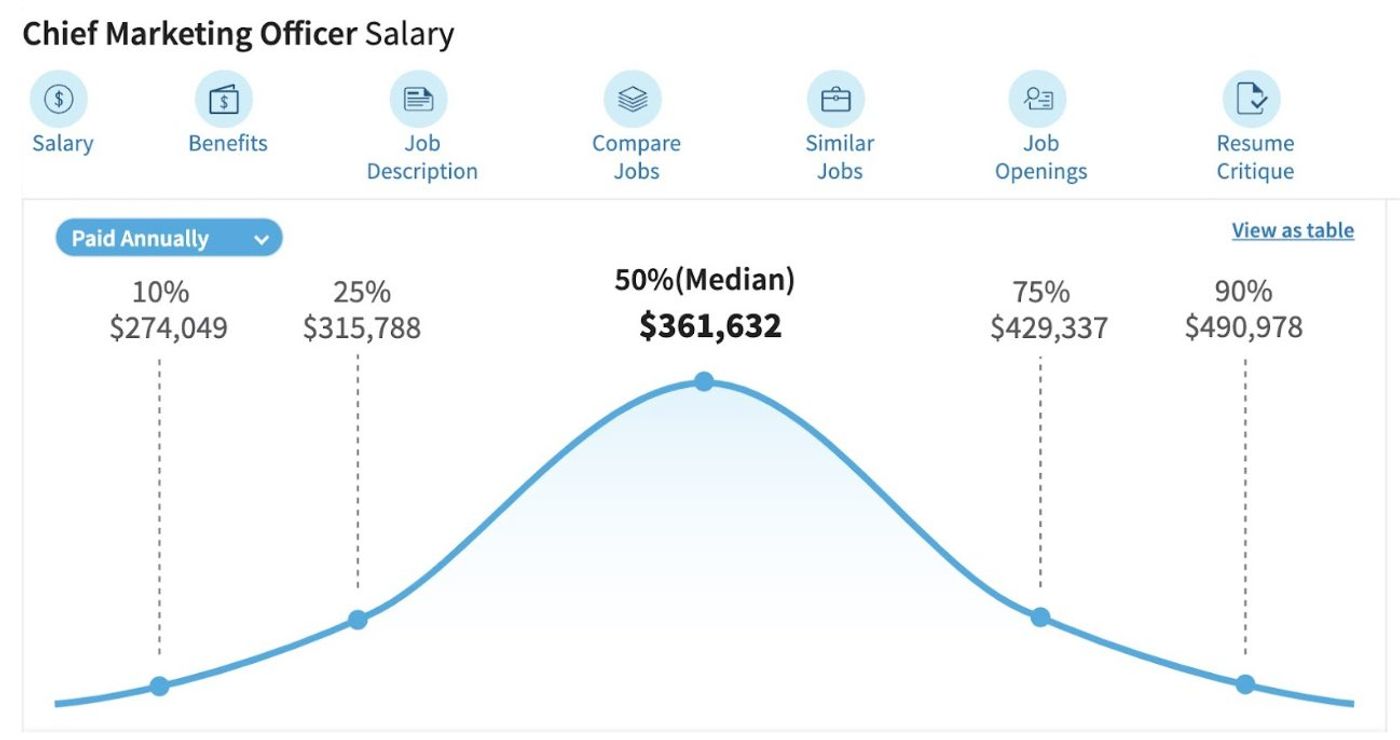
The compensation and bonus structure of a CMO can vary dramatically depending on the company, tenure, skills, education, bonus structure, and industry. According to salary.com a Chief Marketing Officer Salary in the United States ranges between $315,788 and $429,337. On the other hand, Payscale suggests the average CMO salary is $184,263
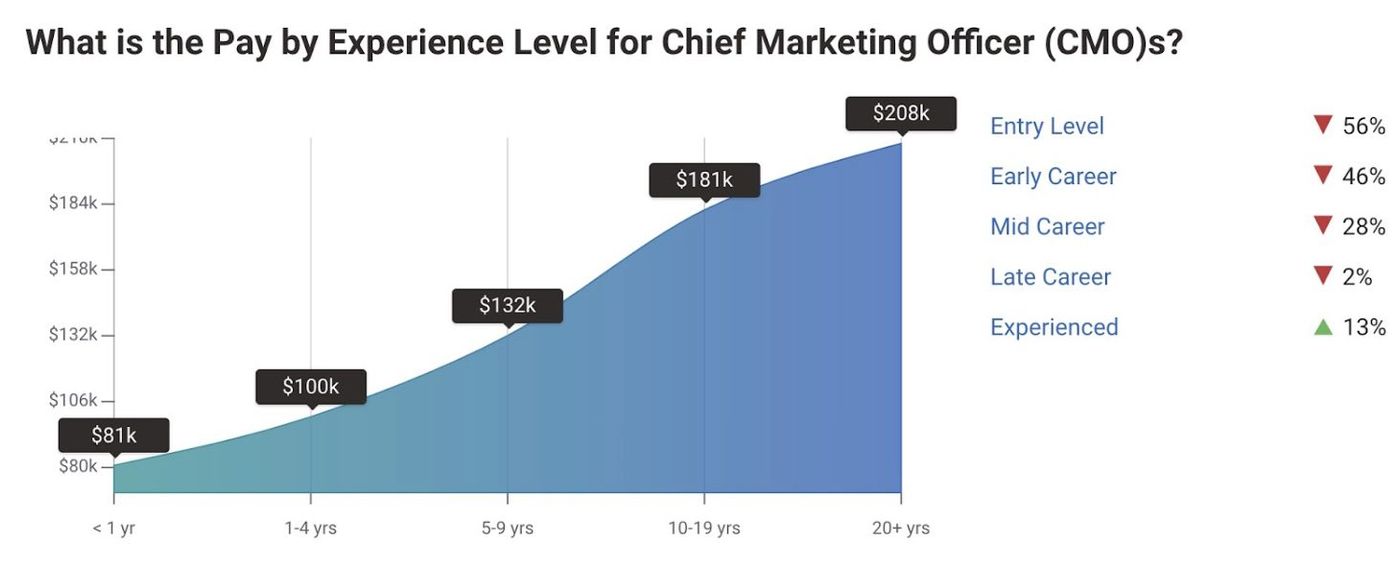
Even though this is a ballpark figure, and rarely perfect it does indicate that CMOs are paid well for their work. Not as well as other C-suite executives but some would argue it is in proportion to the value they add to the company. For instance, NASDAQ listing rules generally require a CEO and CFO to be part of the company, their listing rules state the following:
“Additionally, each Company must certify that it has, and will continue to have, at least one member of the audit committee who has past employment experience in finance or accounting, requisite professional certification in accounting, or any other comparable experience or background which results in the individual's financial sophistication, including being or having been a chief executive officer, chief financial officer or other senior officer with financial oversight responsibilities.”
There is no mention of a marketing function. Even though a CMO is not technically required, it is still incredibly important for a company that is committed to growing and succeeding.
10 CMO statistics you probably didn’t know
- More than 35% of CMOs lean on Generative AI for productivity, personalization, and other use cases. (Source: Emarketer)
- The average tenure for a CMO has been declining since 2014. The average CMO tenure at consumer advertising companies in 2023 was 3 years. (Source: Emarketer)
- Marketing budgets account for 10.6% of overall budgets. (Source: CMO Survey)
- 70% of digital marketing transformations are led by senior marketing leaders such as CMO. (Source: CMO Survey)
- 40% of CMOs still struggle to track the customer across their entire journey. (Source: CMO Survey)
- In 2022, 47% of Fortune 500 CMO roles are held by women, and 53% of the top 100 advertisers' CMO roles are held by women (Source: Spencer Stuart)
- 54% of Fortune 500 CMOs are promoted from within their company. (Source: Spencer Stuart)
- 68% of Fortune 500 CMOs that were hired in 2022 were first-time CMOs. (Source: Spencer Stuart)
- Approximately 66% of CMOs say they have gaps in their tech stacks preventing them from meeting their goals. (Source: CMO Alliance)
- CMOs believe a lack of resources is the biggest blocker to effective cross-collaboration between departments to reach goals. (Source: CMO Alliance)
Pros and cons of hiring a CMO
| Pros | Cons |
| ✅ Brings specialized knowledge and extensive marketing experience to the team | ❌ Can be expensive (high salaries and high bonuses) |
| ✅ Provides strategic direction and aligns marketing efforts with business goals | ❌ Finding a CMO who fits the company's culture is challenging |
| ✅ Leads and manages the marketing team | ❌ Adds to the overhead costs. There needs to be an ROI associated with the CMO |
| ✅ Enhances brand identity and improves market presence | ❌ Time is needed for a new CMO to understand the company and then implement changes |
| ✅ Can introduce fresh ideas and innovative strategies that drive growth | ❌ Risky if the CMO leaves the company before implementing meaningful changes |
| ✅Leverages a wide network for opportunities. | ❌ Possible conflicts with other executives like the CFO, CTO, CIO, or CRO. |
| ✅Can implement automation that improves sales & marketing efficiency | ❌Usually requires some org chart changes which can result in pushback from staff |
Frequently Asked Questions (FAQs)
How much does it cost to hire a CMO?
There are multiple things to consider when hiring a CMO including the sign-on bonus, salary, commissions/bonus, and equity. According to salary.com a Chief Marketing Officer Salary in the United States ranges between $315,788 and $429,337. On the other hand, Payscale suggests the average CMO salary is $184,263.
What is a Fractional CMO?
A fractional CMO is a
part-time marketing executive
(or consultant) who provides high-level expertise and strategic leadership without full-time costs. The flexible and cost-effective approach allows businesses to tap into high-quality marketing talent without having the same financial commitment. They’re becoming incredibly popular since they help businesses level up their marketing quickly without breaking the bank. Fractional CMOs might work 10-20 hours per week for each client they consult with and in some cases they’ll have a team to support their work.
How do I become a CMO?
Becoming a CMO is not a straight path, and there are many ways to achieve the title. However, you would need to have various skills and education to be considered for most roles. Bachelor's Degrees and Advanced Degrees in Marketing and Business are highly desirable.
On top of this, having relevant experience from entry-level marketing positions through to leadership roles is critical. Since this role requires a large degree of management these types of positions are also favorable. Having a network also goes a long way in this industry, knowing the right people to mentor and support you can be the difference between getting an opportunity and not being considered at all.
What’s the difference between a CMO and a marketing consultant?
A Chief Marketing Officer (CMO) is an executive within a company, responsible for the entire marketing strategy, managing a team, and ensuring long-term goals are met. In contrast, a marketing consultant (such as an
email marketing consultant
or
lead gen consultant
) is an external advisor hired to guide on specific marketing issues. They often work with multiple clients on a project basis and can sometimes be hired by the CMO. CMOs focus on long-term integration and comprehensive strategy within one organization, while consultants offer short-term, specialized advice and solutions to various clients.
Keep reading